

Recurring household expenses: a practical system for couples
A simple system for couples to manage rent, utilities, subscriptions, annual bills, due dates, and monthly reimbursements without nagging.

Rent is due on the same day, internet hits the same card, and streaming renews quietly in the background. Yet many couples handle each charge as a brand-new event: one person pays, the other plans to reimburse them, and neither can remember whether the electric bill made it into the last settlement.
Managing recurring household expenses as a couple does not require merging every dollar or monitoring personal purchases. It requires one visible system that answers four questions: what is due, when is it due, who pays it, and how is it shared?
This guide focuses on the monthly routine. If you are still choosing a fair split, start with our complete guide to splitting expenses as a couple or compare scenarios with the couples expense-splitting calculator.
Build a complete map of repeating charges
Open the last two or three months of bank and card statements. Memory tends to miss small subscriptions and annual renewals; transaction history shows what actually left your accounts.
Sort each item into a useful category:
| Type | Examples | How to plan it |
|---|---|---|
| Fixed amount and date | rent, mortgage, internet | record the exact amount and due date |
| Recurring, variable amount | electricity, water, gas | plan from a recent average and update the actual bill |
| Annual or semiannual | insurance, property fees, memberships | save one month’s share at a time |
| Shared subscription | streaming, cloud storage, family plans | confirm who uses it and who owns the account |
| Personal recurring cost | individual gym, phone plan, course | keep it outside the household split unless agreed otherwise |
This prevents two common mix-ups. Not every monthly charge is shared, and not every recurring bill has a fixed amount. Electricity repeats; its cost still changes.
Give every bill a clear rule
A shared list becomes useful when every row contains the same decisions:
- What is this charge for? “Apartment internet” is clearer than “Internet.”
- When is it due? Record when funds must be available, not when someone usually remembers.
- Who is responsible for paying it? Even with autopay, someone should confirm that the charge cleared.
- Which account or card pays it? Joint checking, one partner’s credit card, or an individual account.
- How is it split? Equally, by income, by usage, or through an agreed fixed amount.
- When do you settle? After each bill, once a month, or when the running balance reaches a limit.
You do not need one rule for everything. Rent may be income-based, internet split evenly, and a niche subscription paid by the person who uses it. Fairness does not mean uniformity; it means a system both partners understand and can afford.
If you are deciding where the money should live, compare joint and separate account setups for couples.
What a monthly system looks like
Suppose Jordan and Casey pay $2,100 in rent on the first, $85 for internet on the tenth, and $40 for two shared subscriptions on Jordan’s card. Water and electricity vary, averaging $235 across recent months.
Their expected recurring total is $2,460. They agreed on a 60/40 split:
- Jordan’s expected share: $1,476;
- Casey’s expected share: $984;
- variable bills: updated when the statements arrive;
- settlement: one transfer on the last business day of the month.
The estimate does not erase variation. It provides a baseline. If utilities total $260, the month closes at $2,485 and the extra $25 follows the same 60/40 rule. One slightly higher bill does not force the couple to rebuild their system.
Annual charges belong in the plan too. A $720 insurance renewal due in 12 months represents $60 per month in the household budget, even though it has not reached the card yet. Whether your household uses USD, CAD, or another currency, the method is the same.
Hold a 15-minute monthly check-in
A money meeting does not need to consume an evening. Pick a repeatable time, such as the last Sunday of the month, and open the same list or group together.
Check five things:
- every expected charge was paid and recorded;
- variable bills show their actual amounts;
- a new subscription, installment, or service appeared;
- a previously shared expense is now personal, or vice versa;
- the running balance should be settled now or carried into next month.
This short routine is healthier than a string of reminders throughout the month. It turns “you forgot to pay me” into “what is still open on our list?”
Agree on triggers for changing the system
A review should not mean renegotiating the relationship every time a utility bill moves. Set clear triggers for revisiting the split:
- a meaningful increase or decrease in either income;
- a move or a rent change;
- one partner begins working from home and changes household usage;
- a new or canceled subscription;
- a child, pet, roommate, or family member joins the household;
- a bill changes account owner or payment method.
Outside those events, a broader check twice a year is often enough. Our couple cost-of-living guide can help you see how these recurring bills fit into the full household budget.
Avoid shortcuts that create more work later
“I pay rent; you pay everything else.” Simple on paper, but “everything else” changes. Groceries, utilities, and home services can quietly overtake rent.
“We will even it out later.” Without a record, “even” becomes a guess. Log the expense when it occurs, even if money changes hands only once a month.
“It is on my card, so it is mine.” The payment method does not decide whether a cost is shared. A joint subscription may sit on one card; a personal purchase can still appear in a joint account.
“Autopay handles it.” Autopay prevents a late payment to the provider. It does not calculate what each partner should contribute.
“It is only a few dollars.” Several low-cost renewals can become a meaningful monthly line. Small is not the same as invisible.
Put the routine into TakeControl
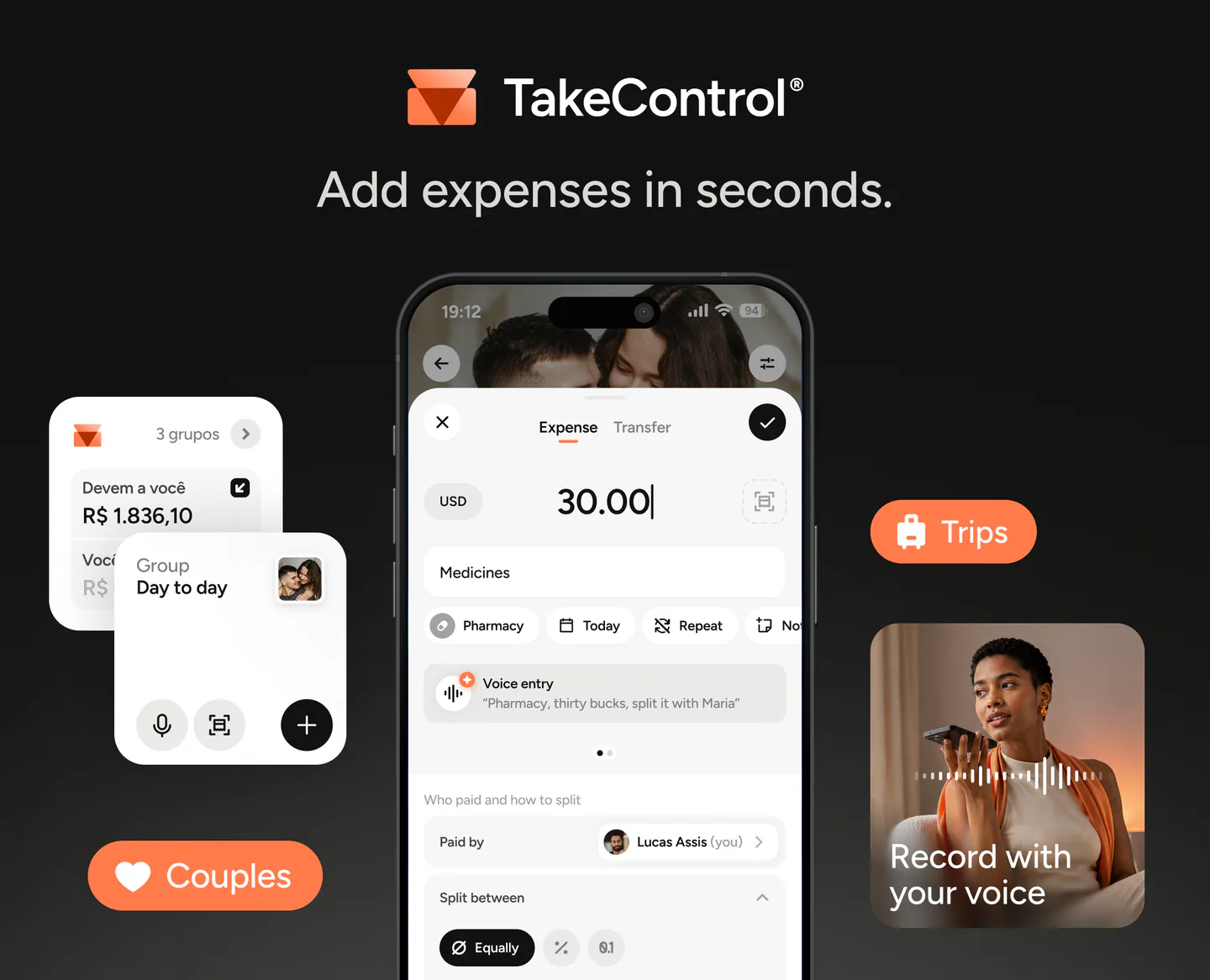
Create a group for your home or relationship. For each expense, choose who paid and split it equally, by exact amount, or by percentage. Turn on recurrence for stable bills so future entries are created automatically.
When a variable bill arrives, enter the actual amount. The balance shows what each person has covered and who needs to reimburse whom, without rebuilding a spreadsheet. The TakeControl FAQ explains the split options and recurring-expense feature in more detail.
The app handles the record; the agreement still belongs to the couple. Use the tool to carry out a clear rule, not to avoid the conversation that creates one.
The best system is the one you can repeat
You do not need the most detailed household budget. You need one both people can maintain during a busy month: a complete list, visible ownership, agreed splits, automated recurring entries, and a short review.
With that foundation, rent, utilities, and subscriptions stop generating the same small dispute every few weeks. You handle exceptions when they happen instead of reconstructing your shared finances from scratch every month.

I created TakeControl to make splitting expenses between couples and on trips simpler. Here, I share tips, app updates, lessons learned, and content to make managing shared expenses easier.
Frequently asked questions
Keep rent, utilities, subscriptions, insurance, and annual charges in one shared list. Record the expected amount, due date, payer, payment account, and split rule for each item. Automate predictable entries and review the list monthly.
Any repeating shared charge can qualify: rent or mortgage payments, utilities, internet, insurance, home services, and subscriptions both people use. Personal plans should stay separate unless the couple explicitly agrees otherwise.
Yes. Use a recent average to plan cash flow, then replace it with the actual amount when the bill arrives. Recurring describes the schedule, not necessarily a fixed price.
There is no universal answer. Equal splitting can suit similar incomes, while an income-based split often protects the lower earner’s personal budget. Couples can also use a different rule for different bills.
Do a brief check each month and a broader review after a move, income change, new service, cancellation, or change in household size. This keeps old subscriptions and outdated splits from running unnoticed.
