

Joint Account or Separate Accounts? What Works Best for Each Couple
Joint or separate bank accounts? Compare the pros, cons, and different ways couples can manage shared expenses and find what works best for you.

When couples start sharing rent, groceries, utilities, dinners, trips, and everyday purchases, there is usually a point when sending money back and forth starts to feel like a financial system of its own.
One person pays for groceries. The other covers the internet bill. Someone books the flights for the next trip. Then, at the end of the month, the same question comes up:
Wouldn’t it be easier to just have a joint bank account?
Maybe.
A joint account can make life significantly easier for some couples. For others, keeping separate accounts provides more freedom and works perfectly well, as long as there is a reliable way to track shared expenses.
And there is a third option that is often overlooked: keep your money separate, but manage your shared expenses together.
So before deciding between a joint account and separate accounts, it helps to understand one important distinction:
Sharing expenses does not necessarily mean sharing all of your money.
Quick answer: joint account or separate accounts?
There is no financial setup that works best for every couple.
A joint account tends to work well when both partners want to centralize some or all of their finances, pay shared bills from one place, and see the money available to the household together.
Separate accounts can make more sense for couples who value financial independence, want to keep using their own banks, credit cards, savings accounts, and investments, and only want to share the expenses that actually belong to the relationship.
There is also a hybrid approach: each person keeps an individual account while the couple opens a joint account specifically for household expenses.
In fact, Canada’s Financial Consumer Agency presents all three arrangements as valid ways for couples to manage money: combining everything, using a joint account only for household expenses, or keeping accounts separate and splitting shared costs.
The important thing is not to choose a system because it feels more serious, more modern, or more committed.
Choose the one that makes your financial life easier.
Before choosing an account, decide what you actually want to share
Many couples begin with the wrong question:
“Should we open a joint account?”
There are more important questions to answer first:
Will both incomes be treated as shared money?
Which expenses actually belong to both of us?
How much should each person contribute?
Do we want personal purchases to be visible to each other?
Which financial goals are individual, and which ones are shared?
Two people can split almost every household expense while keeping the rest of their financial lives completely separate.
And a couple can have a joint account while still keeping individual accounts for personal spending.
The bank account is only a tool.
The financial agreement comes first.
How does a joint bank account work?
A joint bank account is an account owned or operated by more than one person.
Depending on the bank and the country, both account holders can usually deposit money, withdraw funds, make payments, use debit cards, transfer money, and manage bills from the same balance.
In the United States, for example, the Consumer Financial Protection Bureau explains that people named on a joint account can generally make transactions, withdraw or transfer money, and in many cases close the account.
In the UK, joint current accounts similarly allow both account holders to manage money, make payments, pay bills, and use the account for everyday expenses.
The exact legal rights, deposit protection, overdraft rules, and account-closing procedures depend on where you live and which financial institution you use, so it is worth reading your bank’s terms before opening one.
For a couple, however, the everyday idea is straightforward.
Both people put money into the account and use that balance for rent or mortgage payments, groceries, utilities, subscriptions, and other shared expenses.
The contribution does not have to be equal.
For example:
Taylor earns $6,000 per month and Jordan earns $4,000.
They estimate that their shared household expenses are $3,000 per month.
If they decide to contribute based on income, Taylor could deposit $1,800 and Jordan $1,200.
The household bills would then be paid from that shared balance.
The advantages of a joint account
The biggest advantage is centralization.
If most shared expenses come out of the same account, both partners can easily see how much money is available for the household and how much has already been spent.
It can also eliminate many small reimbursements.
Instead of one person buying $180 of groceries and asking the other person to send $90 later, the groceries simply come out of money that already belongs to the household budget.
Joint accounts can be especially convenient when a couple has many recurring expenses:
Rent or mortgage payments, utilities, insurance, childcare, groceries, subscriptions, and other household costs can all be paid from the same place.
For couples who already think of most of their income as “our money,” pooling finances may also feel completely natural.
There is even research suggesting that sharing finances can have benefits beyond convenience.
A two-year study published in the Journal of Consumer Research randomly assigned engaged and newlywed couples to merge their finances, maintain separate accounts, or manage their accounts however they preferred. Couples assigned to merge their money maintained stronger relationship quality over the study period than the other groups. The researchers linked part of the effect to greater financial harmony and alignment around money.
That does not mean opening a joint account automatically improves a relationship, and the study should not be treated as a rule for every couple.
But it is useful evidence against the idea that combining finances is inherently outdated or unhealthy.
For some couples, thinking in terms of “our money” genuinely works.
What are the disadvantages of a joint account?
Centralization also means giving up some independence.
When both people use the same account, personal purchases may become visible to each other.
A lunch with friends, a hobby purchase, a new pair of shoes, or even a gift that was supposed to be a surprise may appear in the same transaction history.
For one couple, that might not matter at all.
For another, it can feel unnecessarily intrusive.
There is also a more important issue:
Shared money needs shared rules.
How much can either person spend without discussing it first?
Can one person make a large purchase from the joint account?
What happens if there is not enough money for the month’s bills?
Who is responsible for monitoring the balance?
Can the account have an overdraft?
A joint account simplifies payments, but it does not remove the need for financial agreements.
There are also practical risks.
In the United States, people named on a joint account generally have broad access to the funds, and creditors may sometimes attempt to collect money held in a joint account when one account holder owes a debt, depending on the circumstances and applicable law.
In the UK, opening a joint account can create a financial association between the two account holders for credit purposes. If the account has an overdraft, either person may also be held responsible for repaying the debt.
This is why a joint account should generally be opened with someone you trust and after both people understand how the account works.
What about deposit protection?
This is another area where the rules vary by country.
In the United States, eligible joint deposits at an FDIC-insured bank fall under a separate joint-account ownership category. Each co-owner’s combined interests in joint accounts at the same insured bank can generally be insured up to $250,000, assuming the account meets the FDIC requirements.
The UK uses a different system and different limits through the Financial Services Compensation Scheme.
Other countries have their own deposit-protection frameworks.
For most couples managing ordinary monthly household expenses, these limits will not affect the decision between joint and separate accounts. But couples keeping significant savings together should understand the protection offered in their country.
How do separate accounts work for couples?
With this approach, each person continues using their own bank account.
Income, credit cards, savings, investments, personal subscriptions, and individual purchases remain separate.
The couple only shares the expenses they have decided belong to both people.
Imagine that during one month:
Alex pays $450 for groceries.
Sam pays $90 for internet.
Alex pays $150 for dinner.
Sam pays $110 for electricity.
They do not need a shared bank account for those expenses to be shared.
They simply need to track who paid for what and calculate the final balance.
If they split everything 50/50, there is no reason to send money after every purchase.
They can add up the shared spending and make one settlement at the end of the month.
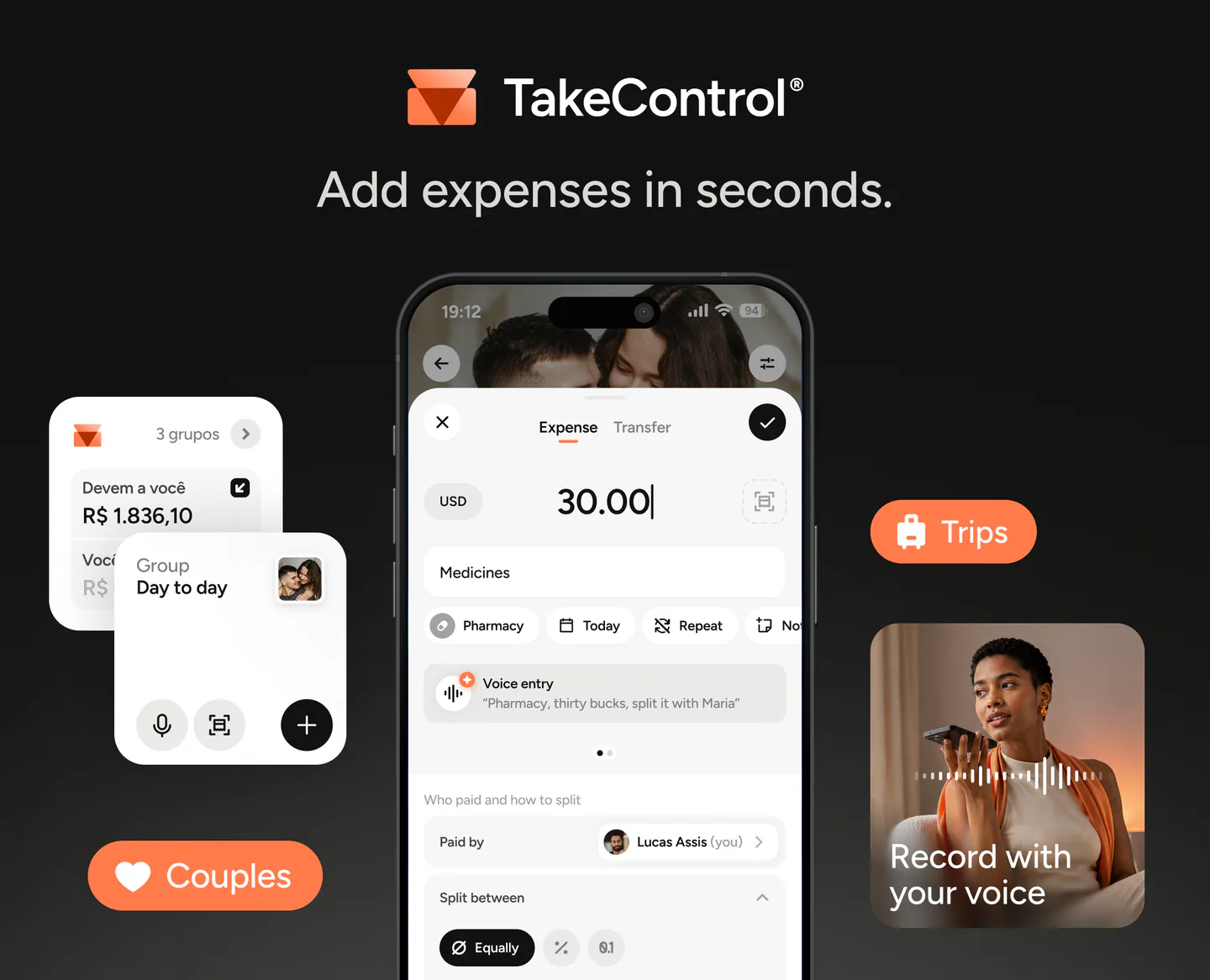
This is the model used by expense-sharing apps such as TakeControl: each person continues paying with their own bank account or card, logs the shared expense, and the app automatically calculates who owes whom.
The biggest advantage of separate accounts: share only what is actually shared
This may be the most important point in this article.
Being in a relationship creates shared expenses.
It does not automatically turn every expense into a shared expense.
You can pay for your gym membership with your own money.
Your partner can buy a gaming console with theirs.
One person can invest using one brokerage while the other prefers another.
Each person can continue using whichever credit card makes sense for their own rewards, cashback, airline miles, or other benefits.
None of those expenses needs to enter the couple’s shared budget.
But rent, groceries, dinner together, furniture, household bills, and your next vacation might.
This creates a simple boundary:
my money, your money, and our expenses.
For couples who value financial independence, that distinction can work extremely well.
But separate accounts have a problem too
Separate finances become difficult when nobody tracks the expenses that are actually shared.
One person buys groceries.
The other pays the utility bill.
Someone orders something for the apartment.
Two weeks later, neither person remembers exactly who paid for what.
At that point, independence can quickly turn into confusion.
The problem is not having separate bank accounts.
The problem is trying to manage shared expenses using memory, screenshots, receipts, text messages, and vague estimates.
This setup needs some kind of system.
It can be a spreadsheet, an expense-sharing app, or any other method that gives both people access to the same information.
Without one, it is easy for someone to eventually think:
“I’m pretty sure I’ve been paying more than you lately.”
The words “pretty sure” are the problem.
A third option: joint account + individual accounts
You do not have to choose between two extremes.
In a hybrid setup, each partner keeps their own account while the couple opens a third account exclusively for shared expenses.
For example:
Taylor’s personal account: income, investments, personal subscriptions, hobbies, and individual spending.
Jordan’s personal account: income, investments, personal subscriptions, hobbies, and individual spending.
Joint account: rent, groceries, utilities, internet, and other household bills.
Each month, both partners transfer an agreed amount into the shared account.
This approach preserves some individual independence while making household expenses easier to centralize.
It is a common enough arrangement that financial guidance from Canada, the UK, and Australia explicitly discusses keeping personal accounts while using shared money for common expenses.
The downside is simple:
You have another bank account to manage.
For some couples, that creates clarity.
For others, it creates an extra layer of financial administration that they never needed.
There is also a fourth option: separate accounts + shared expense tracking
You can get many of the benefits of the hybrid model without opening another bank account.
Each person continues paying expenses using their own preferred payment method, while everything that belongs to the couple is recorded in one shared place.
It sounds like a small difference.
In practice, it changes the entire system.
Instead of pooling money before you spend it, you organize shared spending after it happens.
One person can buy groceries with their favorite credit card.
The other can pay the electricity bill through their own bank.
Both can still see exactly how much each person has contributed and what the balance between them is.
At the end of the week or month, they settle only the difference.
This works particularly well for couples who share many recurring expenses but still want to maintain financial independence.
Comparing the four approaches
| Setup | Biggest advantage | Biggest drawback | Usually works best when |
|---|---|---|---|
| Fully joint finances | Maximum simplicity and centralization | Less individual financial independence | The couple already thinks of most income and spending as shared |
| Individual accounts + joint household account | Balance between independence and centralization | One more account to manage | There are many predictable household bills |
| Fully separate accounts | Maximum independence | Shared costs can become difficult to track | The couple has relatively few shared expenses |
| Separate accounts + shared expense tracking | Independence without losing visibility | Expenses need to be logged | The couple shares many costs but does not want to pool money |
None of these approaches is automatically more mature, responsible, or committed than the others.
They simply solve the same problem in different ways.
A joint account may make more sense if…
Consider a joint account if several of these statements sound familiar:
- Most of your income is already treated as household money.
- You have many recurring shared bills.
- You are both comfortable seeing transactions from the shared account.
- You want bills to come from one central place.
- You do not mind changing part of your banking routine.
- Your financial goals are closely connected.
- You prefer setting aside shared money before spending it.
In that situation, combining at least part of your finances can make everyday money management much easier.
Separate accounts may make more sense if…
Keeping individual accounts may work better if:
- You value financial independence.
- Each person already has banks and credit cards they like using.
- You have separate investments or individual financial goals.
- You only want to share certain expenses.
- You do not want every personal purchase visible to your partner.
- You have only recently started sharing expenses.
- You prefer settling the balance between you periodically.
That does not mean having less transparency.
Two people can maintain separate bank accounts while being completely open about income, debt, savings, financial goals, and household expenses.
Financial transparency and a joint bank account are not the same thing.
What if one person earns much more?
This is a separate decision from the type of bank account you use.
Opening a joint account does not answer how much each person should contribute.
Keeping separate accounts does not mean everything has to be divided equally either.
Imagine one partner earns $8,000 per month and the other earns $4,000.
Their total shared expenses are $6,000.
With a 50/50 split, each person would pay $3,000.
For the first partner, that represents 37.5% of their income.
For the second, it represents 75%.
The couple could instead decide to split expenses proportionally.
One person earns approximately 66.7% of the household income and the other earns 33.3%.
Their $6,000 of shared expenses could therefore be divided into approximately $4,000 and $2,000.
This approach works with any of the account structures in this article.
If income differences are the main challenge in your relationship, you can also use TakeControl’s Couple Expense Split Calculator by Income to compare an equal 50/50 split with a proportional contribution.
Try this before opening a joint account
If you are unsure, you do not have to reorganize your entire financial life immediately.
Try a 30-day experiment.
For one month:
- Clearly define what counts as a shared expense and what stays personal.
- Decide how shared expenses will be divided.
- Track everything each person pays.
- Avoid constantly reimbursing each other for small amounts.
- At the end of the month, look at the final balance and make one settlement.
Then talk about how it felt.
What was annoying?
Was it having to log expenses?
Was it having a balance to settle at the end?
Was it inconvenient for different people to pay different bills?
Or did the system work perfectly well?
If your conclusion is:
“It would be much easier if all of these expenses simply came out of the same pool of money,”
then a joint household account may genuinely improve your routine.
If your conclusion is:
“This worked well, and we like continuing to use our own cards and accounts,”
you may not need one.
The best financial system is the one you can realistically maintain.
Where does TakeControl fit into this?
TakeControl is not a joint bank account, and it is not designed to replace one.
It does not hold or move the couple’s money.
The idea is different: two people can keep their own accounts and payment methods while sharing only the expenses they choose.
You create a group, log who paid for each purchase, and decide how the expense should be split.
Expenses can be divided equally, by percentage, or by exact amounts, and the balance updates automatically to show who owes whom.
Recurring expenses such as rent and subscriptions can also be created so they are added automatically each period.
This makes TakeControl particularly useful for couples who prefer separate finances.
But there is an important point worth being clear about.
If you already pool all of the money used for shared expenses into one joint account and every household purchase comes directly from that account, you may not need an expense-splitting app for those purchases at all.
And that is perfectly fine.
The tool should fit the couple, not the other way around.
So, which option is better?
The most useful answer may be this:
Share enough to make your life easier, but do not share more than you actually need to.
For some couples, that means depositing both incomes into the same account and managing everything together.
For others, it means maintaining two individual accounts and one joint household account.
And for many couples, it may simply mean keeping their money separate while having one place where shared expenses are clearly organized.
There is no level of financial integration that proves one relationship is more serious than another.
What matters is that both people understand the system, believe the arrangement is fair, and can talk about money without relying on assumptions.
Joint account or separate accounts is only the visible part of that decision.
The more important question is:
How do we want to organize what is mine, what is yours, and what is ours?
Download TakeControl for free and organize your shared expenses as a couple.
 Download for iPhone
 Download for Android

I created TakeControl to make splitting expenses between couples and on trips simpler. Here, I share tips, app updates, lessons learned, and content to make managing shared expenses easier.
Frequently asked questions
It depends on how you prefer to manage money. A joint account makes it easier to centralize shared spending, while separate accounts provide greater financial independence. You can also combine individual accounts with a joint household account or keep finances separate while tracking shared expenses together.
Usually, no. Many financial institutions allow two adults to open a joint account without being married, but eligibility and account rules vary by provider and country. Check the requirements of the bank or credit union you plan to use.
Each person can pay expenses normally and keep a record of what they paid. Shared expenses are then divided according to the couple's agreed rule, such as 50/50 or proportional to income. An expense-sharing app such as TakeControl can calculate the running balance automatically.
Yes. You can maintain individual bank accounts and use a spreadsheet or expense-sharing app to track only the purchases and bills that belong to both people.
No. A couple can keep personal accounts and transfer only a portion of their income into a joint account used for shared expenses.
One option is to divide expenses proportionally to income. If one person earns 60% of the couple's combined income and the other earns 40%, shared expenses can also be divided 60/40. There is no rule saying this is always more appropriate than 50/50, but it can prevent shared expenses from taking up a much larger percentage of the lower earner's income.
It can be useful when you have many predictable recurring expenses and want to pay everything from one place. If your main goal is simply to know how much each person has paid and settle the difference periodically, separate accounts combined with shared expense tracking may accomplish the same goal with less banking infrastructure.
The process depends on the bank, account type, and country. You may need to move the remaining balance, change automatic payments, deal with any overdraft or shared debt, and close or convert the account. If there is joint borrowing attached to the relationship, separating does not necessarily remove either person's responsibility immediately. For example, UK guidance warns that either account holder may remain responsible for joint overdraft debt until it is resolved. In the United States, ownership and what happens to funds can also depend on how the account is titled, the account agreement, and applicable state law. For that reason, it is worth understanding the rules before combining significant amounts of money or taking on joint debt.
