

Who pays for the date? A fair way to split bills early in a relationship
The check arrives and nobody moves. Here is when to start splitting costs while dating, which model to pick, and how to bring it up without it feeling awkward.

The check lands in the middle of the table, and for a second neither of you says anything. It is the third date, maybe the fourth, and that two-second silence clearly means something. Who grabs it? Who waits? Is asking “so, how do we want to do this?” going to kill the mood?
That scene plays out every weekend in restaurants, bars, and movie theaters everywhere, and yet almost nobody talks about it before it happens. What follows is a mix of awkwardness, wrong assumptions, and sometimes a quiet resentment that builds up without anyone quite noticing.
The short answer: how to split bills when you start dating
There is no universal rule about who should pay. On the first few dates, the person who invited the other can offer, and either person can suggest splitting. Once dates become frequent, agree before ordering whether you will split evenly, alternate, or contribute according to income. Personal extras stay with the person who chose them; genuinely shared costs follow the method you both accepted.
| Situation | Practical approach | What to agree on |
|---|---|---|
| First few dates | The inviter offers, or you split the check | Say it before paying instead of assuming |
| Regular dates and similar incomes | Split evenly or take turns | Which costs count as shared |
| Very different incomes | Split proportionally | Which income and expenses go into the calculation |
| A plan chosen by only one person | That person covers the upgrade, or you adjust the plan | A budget that feels comfortable to both people |
If a proportional split sounds right, use the couple expense split calculator as a starting point and adjust the result together.
Why talking about money early on still feels so hard
Bringing up money at the start of a relationship carries a weight other conversations do not. There is the fear of sounding transactional by mentioning it at all, the fear of sounding controlling by proposing a system, and the cultural leftover of “whoever asked pays,” which still lingers even in modern relationships where both people work and earn well.
Add to that the fact that, early on, nobody wants to come across as calculating with someone they are just getting to know. So the topic usually just goes unspoken: one person covers a date, the other covers the next one, and that informal tally keeps rolling until someone feels like they are paying more, or until the dates become frequent enough to turn into a real monthly expense.
The problem is not splitting or not splitting. The problem is deciding it on the fly, table by table, instead of agreeing on an approach before it turns uncomfortable. Putting off the conversation also gives different expectations more time to build without either person noticing.
How to split costs at each stage of dating
There is no single model that fits every couple, because every relationship has its own pace, its own income situation, and its own comfort level with the subject. Still, a few principles help you figure out what makes sense at each stage.
Keep the first few dates simple
For the first date or two, the simplest approach is usually the best one: whoever extended the invitation offers to pay, and the other person can accept, insist on splitting, or offer to cover the next outing. There is no need to formalize anything at this stage. It is just dinner or a movie; the amounts involved are still small, and the topic does not yet call for a real conversation.
Once it becomes a routine, it is time to talk
The signal that it is time to organize this is not a date on the calendar, it is frequency. Once you are seeing each other multiple times a week, planning bigger things like a weekend trip, or already splitting the occasional grocery run, the informal “I got this one, you get the next one” starts to break down. That is the moment to sit down, casually, and ask: “how do you think we should handle this from now on?”
Pick a model that works for both of you
There are three common approaches, and none of them is inherently right or wrong:
Even split. Each person pays exactly half of everything shared. This works well when incomes are similar and both of you agree that the simplicity is worth more than fine-tuning every purchase.
Proportional to income. Each person contributes based on what they earn, so whoever makes more pays a larger share. It can reduce the burden on the lower earner, especially when one partner is earlier in their career or still studying. The couple expense split calculator lets you compare this approach with an even split.
Informal rotation. One person covers dinner, the other covers the next movie night, with no running tally. This works well when the amounts are similar and neither of you minds not tracking things precisely; it tends to break down once one partner starts noticing, over time, that they are paying more.
Keep couple expenses separate from personal ones
A common mistake is blending relationship expenses with each person’s individual spending. The movie tickets you both went to see are a couple expense; the streaming subscription only one of you actually uses is not. Drawing that line early prevents things from snowballing into something messier down the road.
Use a tool so nothing gets lost
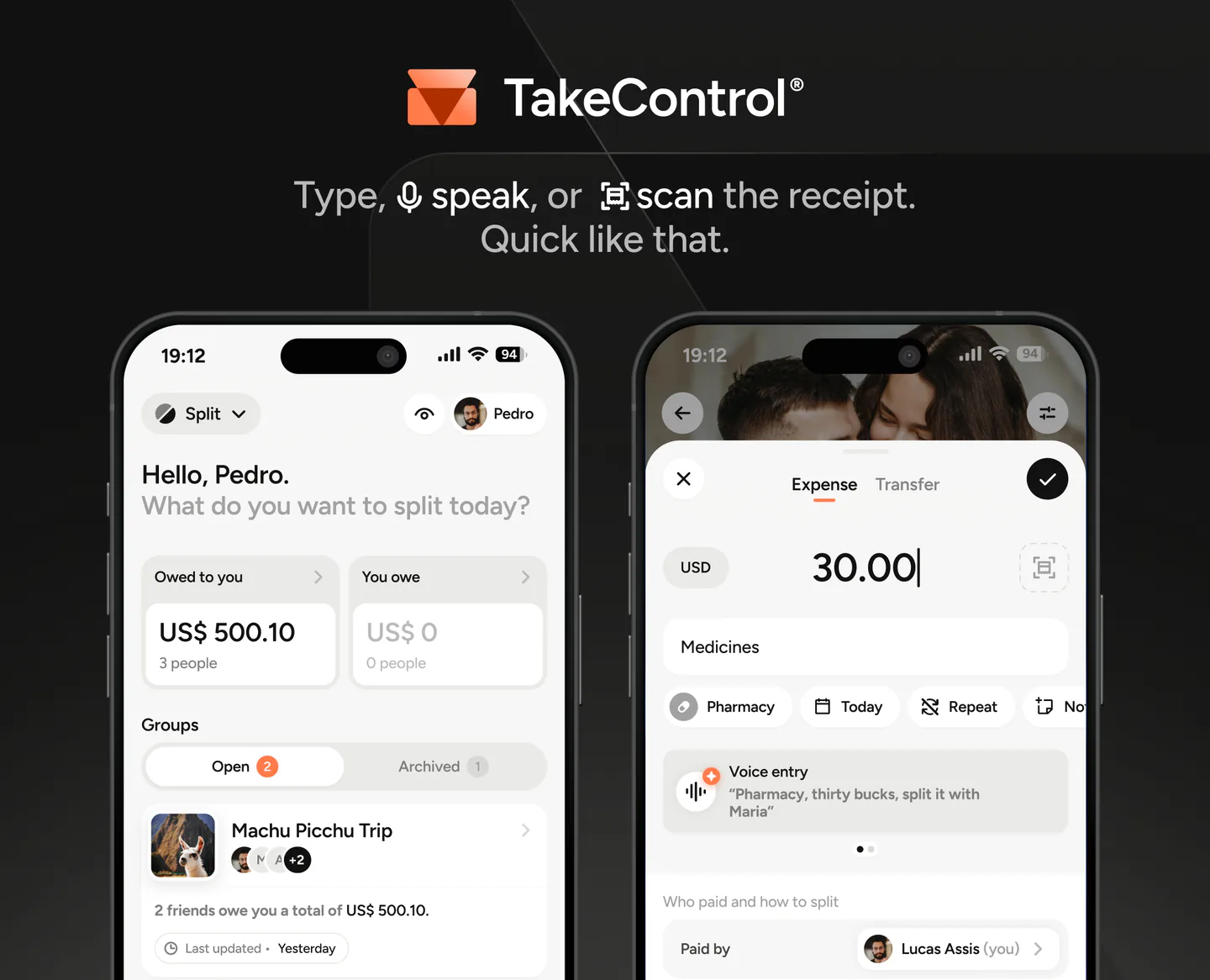
As dates and shared expenses add up, keeping track of everything from memory gets less and less accurate, and that is exactly where small resentments start: “I feel like I have paid for more tickets than you” is a sentence nobody wants to hear, mostly because neither of you is actually sure if it is true. An app like TakeControl handles this without turning dating into a spreadsheet exercise: each person logs what they paid, the app calculates the balance automatically, and shows who owes what to whom, so you are not doing mental math after every outing.
Mistakes that weigh more than they seem to
A few habits look harmless at first but tend to be the real root of later friction.
Leaving it all to memory. After a few weeks, nobody remembers exactly who paid for what. The feeling of “I think I am paying more” sets in even when it is not true, simply because there is no record to check against.
Assuming instead of asking. Assuming your partner will prefer a 50/50 split, or assuming they would rather cover everything, without ever saying it out loud, is the most common recipe for a quiet misunderstanding.
Treating the arrangement as permanent. Whatever model you land on in month two of dating does not have to be the one you use in month twelve. Income changes, routines change, and revisiting the arrangement now and then is normal, not a sign something is wrong.
Ignoring how this plays out differently across couples. The old script of “the man pays” simply does not map onto every relationship, and that is actually an advantage: without that default script, many couples come to the money conversation without the baggage that trips up others.
What actually matters in this conversation
In the end, the model you choose matters less than your willingness to talk about it openly. A couple that agrees on splitting evenly and feels good about it is in a much better spot than a couple that never discussed anything and keeps a silent tally in their heads.
Treating the topic as organizing, not as keeping score, completely changes the tone of the conversation. It is not about distrust; it is about making sure neither of you feels like you are carrying more than your share, and that the relationship never starts to feel, even a little, like a financial burden. The earlier this habit forms, the more natural it becomes, and the less room there is for money to turn into an argument later on, whether you end up moving in together, getting married, or just dating for a few more months.
Once shared costs stop being occasional, continue with the complete guide to splitting expenses as a couple.

I created TakeControl to make splitting expenses between couples and on trips simpler. Here, I share tips, app updates, lessons learned, and content to make managing shared expenses easier.
Frequently asked questions
There is no fixed rule. It is common for whoever did the inviting to offer to pay, but splitting the bill from the start is a completely reasonable option too, and it avoids any awkward expectations.
There is no exact date for this. The real signal is frequency: once you are seeing each other several times a week, taking trips together, or sharing everyday costs, it is worth sitting down and agreeing on a model before it becomes a source of tension.
It is not wrong, but it can weigh more heavily on whoever earns less. When the income gap is significant, many couples prefer splitting costs proportionally to what each person earns instead of a strict even split.
Frame it as organizing, not as keeping score. Saying "how should we handle this going forward" lands very differently than bringing up numbers after the fact. The earlier and more casually this conversation happens, the less weight it carries.
Yes, especially once shared spending picks up. An app like TakeControl tracks who paid for what and shows the running balance between the two of you automatically, so money stops being something you have to bring up in every conversation.
