

Group backpacking: the financial agreement to make before you leave
A practical guide to organizing and splitting expenses on a group backpacking trip, keeping money stress out of the adventure.

The itinerary had been planned for months: ten days crossing new cities with four close friends. Flights booked, hostels reserved, excitement through the roof. What nobody planned for was the moment, on day three, when someone raised an eyebrow and asked: “Wait, how much has each of us spent so far?” The silence that followed was more uncomfortable than any crowded dorm room.
Money on a group backpacking trip is something almost everyone ends up dealing with and almost no one plans for properly. The trip is incredible, the memories are permanent, but the running tally of who owes what quietly grows into a weight that drags on the experience.
Why money becomes a problem on the road
In the daily rhythm of travel, expenses pile up quickly and in unpredictable ways. Someone covers the taxi, another person picks up dinner, a third buys the museum tickets. After two or three days, there is already a web of crossed payments that no one can track mentally.
The problem is not the generosity of whoever pays; it is the absence of a record. Without clear tracking, everyone holds a different version of what they owe or what is owed to them. Different versions of the same story are the perfect fuel for a conflict that does not need to exist.
Backpacking adds specific challenges that make financial tracking harder than in everyday situations:
Foreign currency. Converting values in your head while hungry, tired, and trying to read a menu in another language is a recipe for mistakes.
Different travel styles. Some people want the most interesting restaurant in the city; others are happy with a corner snack bar. When the group splits the meal equally, whoever ordered the salad may end up subsidizing the steak.
Unplanned expenses. The bag that ripped, the bus they missed and had to replace with a taxi, the last-minute ticket to a suddenly famous attraction. None of these were in the budget, but all of them require someone to pay and the group to settle later.
How to organize finances before you leave
The best strategy for avoiding conflict starts before anyone steps on a plane. An honest conversation about money during the planning stage saves hours of tension on the road.
Agree on a cost-sharing model
There are essentially three ways to split expenses on a backpacking trip, each with real advantages and trade-offs:
Split everything equally. The group divides all expenses evenly, regardless of who paid. This works best when everyone has similar budgets and tastes. It is the simplest model to run but requires consistent logging.
Split by category. Collective expenses like intercity transport and accommodation are divided equally. Meals and personal purchases stay individual. This model respects budget differences without making the group accounting complicated.
Shared pool. The group contributes a set amount upfront to cover common expenses. When the pool drops below an agreed threshold, everyone tops it up again. Works well for small, high-trust groups.
Talk to your group and pick the model that fits everyone. Documenting the decision somewhere visible, like the description of your WhatsApp group, prevents misunderstandings later.
Choose an app before you go
Trying to manage trip expenses in a spreadsheet or a notebook works for highly organized groups but is too fragile for the pace of a backpacking trip. An expense-splitting app solves the problem far more practically.
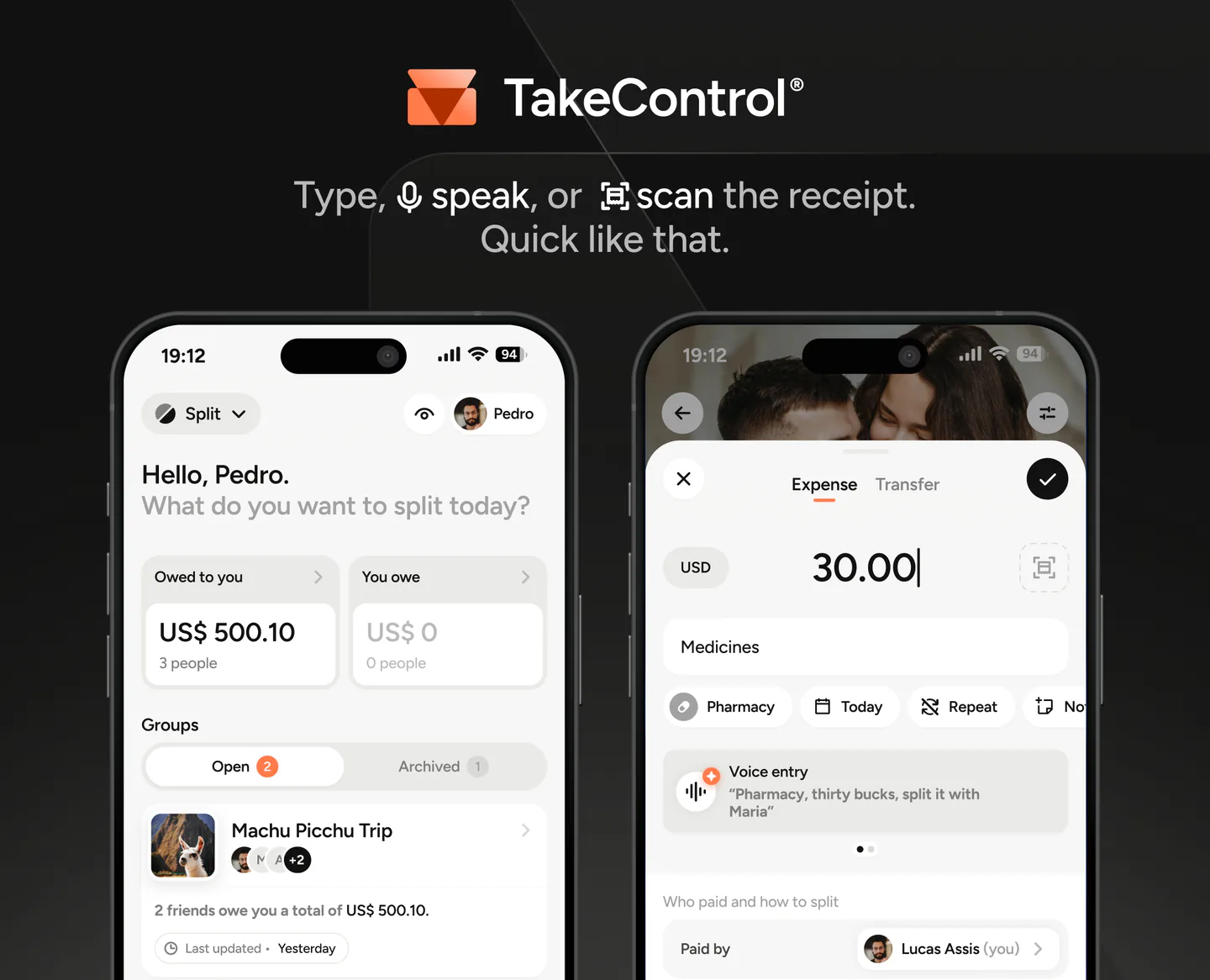
TakeControl, for example, lets anyone in the group log an expense the moment it happens. The app automatically calculates each person’s balance and shows clearly who owes what to whom. If expenses are in a foreign currency, logging the amount in the local currency keeps everything documented even if the conversion happens later.
Agreed on before departure, the app removes the burden of someone having to be the group’s unofficial accountant, a role that creates friction even among the closest friends.
Build a logging habit on the road
The biggest trap in travel finance is not a lack of tools; it is forgetting to log things. In the pace of a busy travel day, it is easy to let a payment slip by and only remember it two days later when memory is already unreliable.
A simple habit fixes this: at the end of each day, someone in the group does a quick review of that day’s spending and logs anything that was missed. Five minutes in the evening prevents an entire argument weeks later.
Handling specific backpacking situations
Personal expenses within a group trip
Even in groups that split everything equally, some expenses clearly belong to one person. The craft beer only one person wanted to try, the optional tour that not everyone joined, the expensive souvenir bought as a personal gift.
The clearest rule is: if the expense did not benefit the group, it does not go into the shared pot. Log these separately in the app and keep the collective split only for what was genuinely shared.
When spending levels differ
Not every group travels on the same budget, and that is completely normal. One person might want the more comfortable hotel while another prefers the cheapest hostel available.
The most respectful solution is to keep those expenses outside the shared account. Each person pays their own accommodation individually; transport and activities that everyone wants to do go into the split. There is nothing wrong with adjusting the model mid-trip if a new situation comes up, as long as the group talks openly about it.
Settling up at the end of the trip
When the trip is over, the app shows each person’s balance. Anyone who owes money transfers to whoever has a positive balance. With a good app, this settlement is usually straightforward: payments are minimized to the fewest possible transactions, and no one needs to crunch complex numbers.
You can also settle up at intervals during the trip, weekly or at natural breakpoints. For longer trips, settling weekly keeps balances from growing too large and prevents the final settlement from becoming a high-stakes event.
What a well-organized trip actually feels like
When the financial side is under control, the group is free for what actually matters. Decisions about the next destination, where to eat, or what to do the next morning feel light. Nobody is mentally calculating who owes what or quietly resenting feeling like they are paying more than their share.
The honest financial conversation before the trip is the cheapest investment a group of backpackers can make. It costs nothing, removes the single biggest source of conflict on group trips, and ensures that the only thing anyone remembers afterward is the stories, not the arguments.
Conclusion
Group backpacking is one of the richest experiences life can offer, but only when the group arrives with the right financial agreements in place. Choosing a cost-sharing model, picking an app before departure, and building a habit of logging expenses are three simple steps that make an outsized difference.
The freedom of backpacking does not have to include the anxiety of not knowing what you owe or how many friends are waiting to bring it up. With minimal organization, money goes back to being what it should be on a great trip: the tool that makes the experiences possible, nothing more.

I created TakeControl to make splitting expenses between couples and on trips simpler. Here, I share tips, app updates, lessons learned, and content to make managing shared expenses easier.
Frequently asked questions
The most practical approach is to have someone pay and log everything in a shared expense app like TakeControl. The app calculates who owes what automatically, so you never have to do the math mid-trip.
Talk about it before you leave. The group can split only shared costs like transport and activities, while each person covers their own food and accommodation separately. The key is agreeing on the model upfront.
Use an app that supports multiple currencies. Log each expense in the local currency and let the app handle conversions. This keeps records accurate without anyone doing mental math in a busy market.
At least two weeks before departure. Agree on how expenses will be split, whether to use a shared fund, and which app everyone will use. Sorting this out early prevents tension during the trip itself.
It depends on the group. A shared pool works well for small groups with similar spending habits. For larger or mixed-budget groups, logging everything in an app and settling at the end is more transparent and fair.
