















Moving costs hit before the first month
Security deposit, first month’s rent, movers, furniture and the first big grocery run. One of you fronts it, the other promises to pay back later.
Security deposit, movers, furniture, rent and utilities: track it all in one place, pick a fair split and see who owes whom.
Free to get started · iOS and Android

According to a 2019 Pew Research Center analysis, 59% of US adults ages 18 to 44 have lived with an unmarried partner at some point. Moving in together is common, but agreeing on the bills is still the hard part.
Security deposit, first month’s rent, movers, furniture and the first big grocery run. One of you fronts it, the other promises to pay back later.
Rent, electricity, gas, internet, renters insurance and streaming come due on different days and on different cards.
The couch was one person’s, the TV was shared, the bed went on the other’s credit card. Without a record, the math gets lost.
Three steps so your new place does not start with mental math.
Add whoever is moving in with you. Household bills stay separate from trips and friends.
Rent, utilities and internet go in as recurring expenses. Moving costs and furniture, as one-off or installment purchases.
TakeControl updates the balance with every expense and shows the monthly settle-up, no spreadsheet needed.
50/50, by income or by exact amount. You can use one rule for rent and another for groceries.
From the bills that come due every month to the big purchases of moving day.
Add rent, utilities, internet and subscriptions once. The app adds them again every month.
Set a monthly limit for groceries and the home and see how much you have spent.
Note who bought each piece of furniture and keep the receipt. Two years from now, nobody has to remember.
A couch paid in 12 monthly installments is added one payment at a time, each in its own month.
Send a light reminder for the monthly settle-up without turning the conversation into a bill.
The widget shows your household balance and budget without opening the app.
A household spreadsheet works until the first bill that changes amount or the first installment purchase. In TakeControl, the balance updates as you add expenses.
It works, but someone has to keep it up.
| Date | Expense | Amount | Split |
|---|---|---|---|
| 3/1 | Rent | $2,400 | =C2*60% |
| 3/5 | Internet | $70 | =C3/2 |
| 3/10 | Couch | $900 | =C4*60% |
Your household balance takes care of itself.
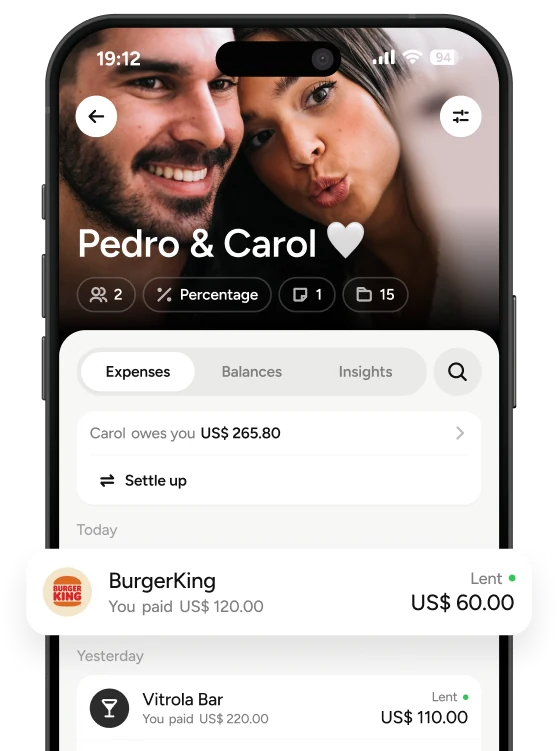
Download for free and set up your household group today.
Calculators and guides to plan the move and agree on the bills before the first one arrives.

Estimate your move-in costs and monthly budget before you sign the lease.

Bigger bedroom, private bathroom or parking: work out what each person pays.

The pros and cons of each setup for couples sharing a home.

How much a couple spends each month and how to build a household budget.

How to prepare for the bills that only come once a year, like insurance.

The money agreement you need when you share a house with more people.
Straight answers to agree on the bills before you carry in the first box.
List your recurring bills (rent, electricity, gas, water, internet, renters insurance), your variable costs (groceries, takeout) and your moving costs. Pick a rule for each group of expenses: 50/50, by income or by exact amount. In TakeControl, recurring bills repeat automatically and the app shows your balance with every expense. For everyday couple expenses, see how to split expenses as a couple.
If your incomes are similar, 50/50 usually works. If one of you earns much more, splitting by income keeps rent from weighing more on the lower earner: with incomes of $6,000 and $4,000, the split is 60% and 40%. Try it with your own numbers in the couple expense split calculator.
There is no fixed rule. If only one of you has the cash, that person pays and the other pays back their share over time. Add the deposit to your household group with a note on who paid. Deposit limits depend on your state: in California, for example, most landlords have been limited to one month’s rent since July 1, 2024. The deposit usually comes back when the lease ends, and your record shows whose share is whose.
Things one person bought with their own money for personal use can stay out of the group. Anything for the home that one person paid for should go in the group, with a note on who paid. That way, if you ever move out, it is clear who paid for what.
Not on its own. Only a handful of states, such as Texas, still recognize new common-law marriages, and even there you generally need to agree that you are married and present yourselves as a married couple. In most states, unmarried partners do not get the property rights of a married couple, so some couples sign a cohabitation agreement. If in doubt, talk to a family law attorney in your state.
Create a group for the home and agree on what is shared (rent, utilities, cleaning supplies) and what is personal. Rent can be split by room size with the rent split calculator, and utilities equally. Read our guide to the financial agreement for a shared house.
Work out the share for the days that person lived there and add that month’s bills with the exact amount. Then check the final balance in the group and record the settle-up. The history shows everything each of you paid since moving in.
Yes. TakeControl is free to start, with up to 6 groups and up to 8 expenses a day, recurring bills and budgets. TakeControl PRO unlocks unlimited entries and no ads.