

Group food delivery: who pays what when everyone orders something different
Splitting a group delivery order sounds easy until everyone's totals don't match. Here's how to settle the bill fairly without the awkward silence.

It was Friday evening and five people had five completely different cravings. One wanted sushi. Another wanted pizza. Someone was eating light and just wanted a salad. And the last person only agreed to join if they all used the same app to share a discount code.
In the end, they compromised, placed a combined order, and the food arrived. Great.
Then it got complicated. Who covers the delivery fee? One person’s combo was $18, another’s was $9. Do you split it evenly or by what each person ordered? What about the shared appetizer? And what about the friend who left before the food arrived?
Group delivery is one of the most common situations where money tension sneaks into what should be a relaxed night in.
The short answer: how to split a group delivery order
Each person pays for their own items. Shared items are divided only among the people who had them, while common fees follow the method agreed before checkout. Item-specific discounts stay with the person who ordered that item; an order-wide coupon can be allocated using the same method as the shared fees.
| Part of the bill | How to split it |
|---|---|
| Individual item | Entirely to the person who ordered it |
| Shared item | Among the people who had it |
| Delivery and service fees | Evenly, or proportionally if agreed beforehand |
| Item discount | To the person who ordered that item |
| Order-wide coupon | Among participants using the agreed method |
For repeat orders and other shared costs, see how to split group expenses without stress.
Why splitting delivery is trickier than it looks
The problem starts before the food even arrives. When each person orders something at a different price point, an even split is already unfair from the start. Whoever ordered less is essentially subsidizing whoever ordered more, without anyone agreeing to that.
Then come the shared items: the two-liter soda, the extra dipping sauce, the bread everyone ate. How do those factor in? And how should the group handle delivery, service fees, and coupons applied to the full order?
There’s also a timing problem. The total only appears at the end, right when the food arrives and everyone’s attention is on eating, not settling up. The person who placed the order spent more on their card and needs to be reimbursed, but may not know exactly how much to ask each person for. The result: they either undercharge out of awkwardness, accidentally overcharge, or just let it go and absorb the loss themselves.
And then there’s the classic: “I’ll Venmo you later.” That “later” can take days or never arrive at all.
How to get organized before placing the order
The good news is that group delivery chaos has a solution, and it starts before you hit the confirm button.
Agree on a method before you build the order
Someone needs to be the person who places the order. But before putting together the cart, the group needs to agree on how to split it. Two main options:
Pay for what you ordered: the fairest approach when totals vary significantly. Each person pays the price of their item plus an equal share of the delivery fee.
Split everything evenly: works well when everyone’s orders are roughly the same price, or when the group already has this as a standing agreement. It avoids calculation but can create quiet resentment if someone feels they got the short end.
Agreeing upfront saves explanation later.
Write down what each person ordered and the price
This seems obvious, but it’s the step most people skip. By the time the food arrives and the energy is on eating, nobody remembers who ordered what. Take a screenshot of the order summary before confirming, or jot it down in a shared note.
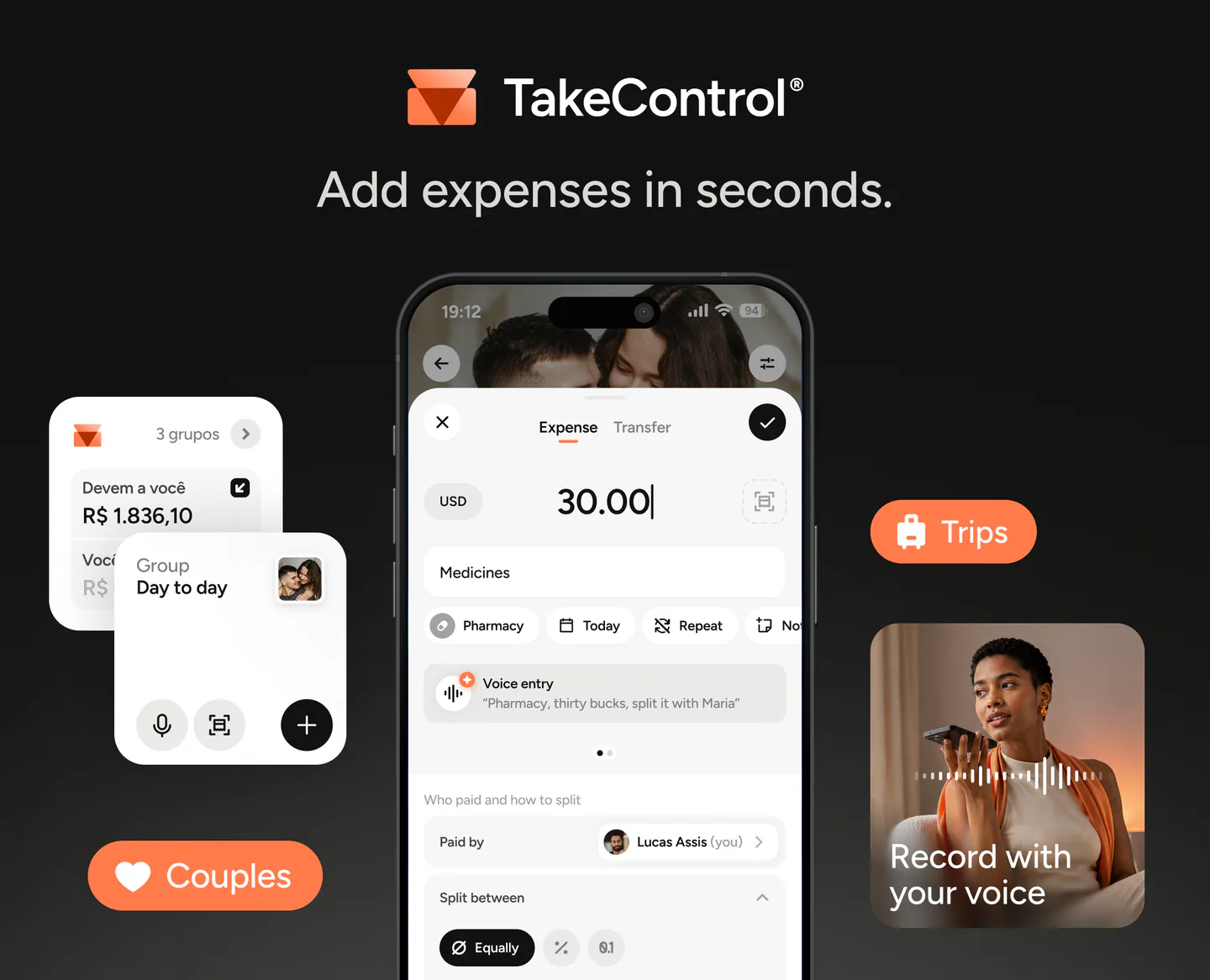
If you use an expense-splitting app like TakeControl, you can log each item by person right then and there. The balances calculate automatically, no mental math required.
Decide how shared items get handled
A shared soda, a side everyone picked at, an extra dipping sauce: these get split equally among everyone who had them. Agree on this upfront and include it in the final calculation. A simple rule: what everyone ate, everyone pays for.
Agree on how to allocate fees and discounts
Splitting delivery and service fees evenly among everyone receiving the order is the simplest default. A proportional allocation based on item totals also works when everyone agrees before checkout. Apply the same care to discounts: an item discount belongs to the person who ordered it, while an order-wide coupon should follow one clear rule for the whole group.
The rules that prevent confusion afterward
Getting organized beforehand solves half the problem. The other half depends on when and how payment happens.
Pay when the food arrives, not “later”
The best time to settle is in the moment, while everyone is still together and the food just arrived. Anyone who left before delivery can transfer their share based on the estimated total before heading out.
Leaving it for later increases the chances of genuine forgetfulness, and the awkwardness of having to follow up.
Skip the “I’ll send it later” as a default
“I’ll send it later” works fine for people who actually send it later. For everyone else, it’s a debt disguised as a promise. If you organized the order, there’s nothing uncomfortable about asking for payment right away. It was agreed upon, not a surprise request.
A low-key way to frame it: “I logged it in the app, it looks like you owe about $X. Whenever you’re ready.”
Log it before you forget
If everyone’s already left and the tab is still open, record it right away. Memory of what each person ordered fades quickly. Apps like TakeControl let you add the expense afterward and split it by exact amounts per person, no spreadsheet needed.
The log also becomes useful for next time: if your group orders together regularly, you already have a history of what each person typically spends.
When someone always disappears at payment time
Every group has that one person who shows up for the food but vanishes when it’s time to pay. It’s not always bad intent; sometimes it’s genuine distraction, sometimes a financial situation they don’t know how to bring up.
For repeat forgetters, a friendly reminder message works most of the time. For something more sensitive, a direct, private conversation tends to work better than a public nudge in the group chat.
What rarely works is silence. The person who paid feels resentful, the pattern repeats, and what should have been a fun, low-effort evening becomes a recurring source of friction.
Closing thoughts
Ordering delivery with friends is easy. Splitting the bill fairly can be too, as long as the group settles on the rules beforehand instead of trying to untangle the mess once the food is gone.
Split by item when totals vary. Allocate fees using the method the group agreed on. Collect payment in the moment, not later.
With an app that tracks who ordered what and calculates everyone’s share automatically, the tedious part gets smaller. What’s left is more time for the part worth doing: eating together.

I created TakeControl to make splitting expenses between couples and on trips simpler. Here, I share tips, app updates, lessons learned, and content to make managing shared expenses easier.
Frequently asked questions
The simplest default is to divide the fee equally among everyone receiving the order. If the group prefers to allocate fees in proportion to item totals, agree on that before checkout.
In that case, split by item: each person pays for what they ordered plus their share of the fees under the method the group agreed on. Splitting everything equally when totals vary widely rarely feels fair to the person who ordered less.
Group ordering and split-payment features vary by platform and can change. Check the options in the delivery app you use; if one person pays upfront, record every item and fee before collecting from the group.
Ask for payment right when the food arrives, while everyone is still together. Sending a payment request in the moment is much more effective than relying on an 'I'll send it later' that never comes through.
TakeControl lets you log each person's order and calculates everyone's balance automatically, including shared charges under the group's chosen method. No mental math or spreadsheet needed.
