















How to split travel expenses as a couple
Choose a fair way to share flights, hotels, points, meals and activities when your incomes, budgets or card limits differ.

One partner books the flights after finding the best schedule. The other puts the hotel on a card with enough available credit. Once they arrive, one pays for dinner and the other orders the ride back. Without a clear agreement, “we’ll sort it out later” can become an argument in the middle of the vacation.
Splitting travel expenses as a couple does not automatically mean cutting every charge in half. It means choosing a method that fits both budgets, is clear before anyone books and still makes sense when the last refund posts.
Start with the budget, not the percentage
Before choosing who pays what, each person should say what they can spend without compromising regular bills, emergency savings or the month after the trip. The plan should fit the lower comfortable limit — unless the partner who wants a more expensive trip explicitly offers to contribute more.
Estimate the trip by category:
- flights and transport to the destination;
- lodging and mandatory booking fees;
- local transportation;
- meals and groceries;
- activities, tickets and travel insurance;
- luggage, connectivity and other extras;
- a buffer for changes or unexpected costs.
If the total is already uncomfortable for one person, a different split does not make the trip inexpensive. Dates, destination or travel style may need to change. For the broader money conversation, see the complete guide to splitting couple expenses.
Define shared and personal expenses
A useful boundary is simple: a shared expense benefits both people and was accepted by both.
The hotel, transportation used together and meals eaten together usually belong in the joint trip budget. Personal shopping, gifts, a solo spa visit or an activity only one partner takes do not. Upgrades deserve their own rule. If both are happy with a $240 room but one person wants the $340 suite, they can split $240 under the normal method and assign the extra $100 to the person who requested it.
Also decide what happens when one person changes a flight for a personal reason or skips a nonrefundable activity. You do not need a contract for every possibility; you need one principle you can apply without negotiating under pressure.
Choose a splitting method
No method is universally fair. These four cover most couple trips:
| Method | When it may work | Main risk |
|---|---|---|
| 50/50 | similar available income and travel preferences | the same amount can create very different strain |
| Income-proportional | a meaningful income or cash-flow gap | requires openness and an agreed percentage |
| By category | one handles flights and the other lodging or meals | category totals may end far apart |
| Shared travel fund | both save before booking and pay from one pool | contributions and leftover money need a rule |
A hybrid is often practical: split flights and lodging 60/40, daily meals 50/50, and keep personal purchases separate. You can test an income-based ratio with the couple expense split calculator.
Write the method in one sentence: “Large bookings and shared costs at the destination are 60/40; individual extras stay with the person who chose them.” That is far clearer than “we’ll take turns.”
Handle flights, hotels and points explicitly
Flights
Buying separate tickets is straightforward, but the products may not be equivalent. Baggage, seat selection, airport, refundability and schedule can change the real cost. A premium chosen for personal preference can stay personal. Flexibility that protects the entire trip may reasonably be shared.
Lodging
Because both people use the room, lodging usually follows the default split. Include required taxes and booking fees. Separate individual minibar, spa or laundry charges. When a refund arrives, apply it against the original lodging expense instead of treating it as unrelated income.
Points, miles and card benefits
Travel rewards do not have one permanent cash value. Agree before booking whether the points are a gift, the owner’s contribution or worth an agreed cash reference available at that time. Do not assign a convenient value after prices change.
Treat card benefits the same way. Lounge access may simply be a perk; a fee charged specifically for a guest needs a decision. And available credit is not a contribution: the person who placed both bookings on a card still advanced money for the trip.
Example: a $4,000 trip split 60/40
Jordan brings in 60% of the couple’s available income and Casey 40%. They use that ratio only for shared travel costs.
Their joint budget is:
- flights: $1,400;
- lodging: $1,300;
- local transport and meals: $800;
- activities both selected: $500.
The $4,000 total gives Jordan a $2,400 share and Casey a $1,600 share.
Jordan pays $1,900 for flights and activities. Casey pays $2,100 for lodging, rides and meals. Although more charges went on Casey’s card, Casey’s agreed share is only $1,600. Jordan transfers $500 at settlement. Casey’s separate $120 shopping purchase never enters the calculation.
Alternating cards might have looked roughly even. A shared balance shows what each person actually contributed.
Track as you go and settle once
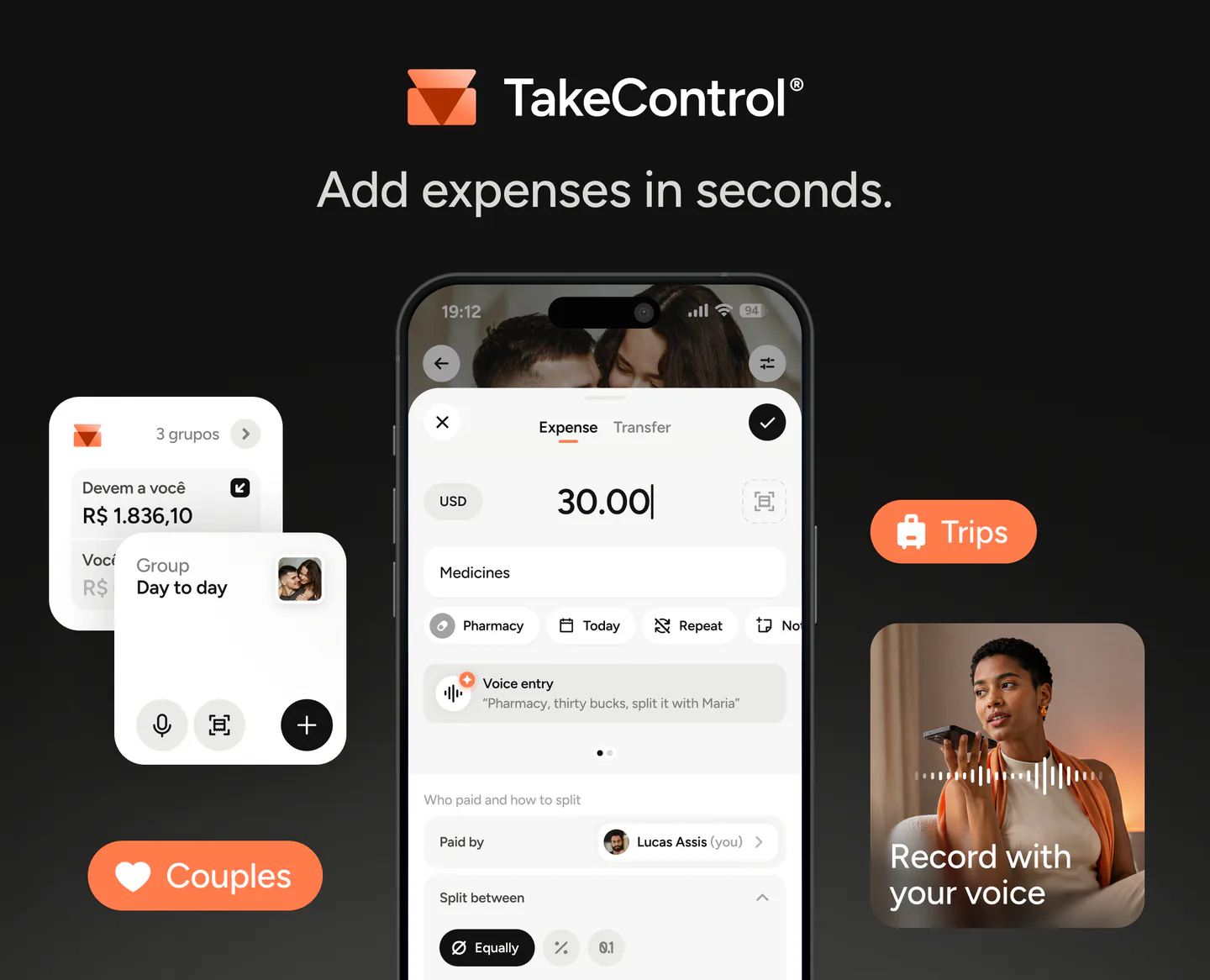
Create a dedicated trip group in TakeControl and record:
- the amount and currency paid;
- who paid;
- who participated;
- a useful category or short description;
- a different split when an expense is an exception.
The group can use a default rule such as 60/40 while one expense uses another split. TakeControl also works offline and syncs later, which helps during flights, road transfers and unreliable roaming. For international plans, the guide to splitting travel expenses in multiple currencies explains how to preserve original amounts and avoid double conversion.
There is no need to send a transfer after every coffee. Watch the balance so one person is not financing the entire trip, then review bookings, refunds and pending card charges before making one net settlement.
A pre-booking checklist
- share the amount each person can comfortably spend;
- choose a travel style that fits that limit;
- define shared costs and personal extras;
- pick 50/50, proportional, category-based, pooled or hybrid splitting;
- agree on upgrades, rewards, benefits and cancellations;
- track who paid without confusing card use with the final contribution;
- review the last charges and settle the net balance.
A good rule does not need advanced math. It needs to be explicit, affordable and accepted by both people. Download TakeControl, create the trip group and spend your time discussing the itinerary — not reconstructing the bill after you get home.
Product limitation: TakeControl calculates and records balances, but it does not move money and has no web app. The group pays through its preferred bank or payment service and can then record the settlement.
Sources and verification
- Couple expense split calculator — TakeControl (Accessed on )
- TakeControl — plans and features — TakeControl (Accessed on )

I created TakeControl to make splitting expenses between couples and on trips simpler. Here, I share tips, app updates, lessons learned, and content to make managing shared expenses easier.
Frequently asked questions
It depends on each person’s available income and the trip both want. A 50/50 split can work with similar budgets; an income-proportional split may be more sustainable when earnings differ. Couples can also use different rules by category.
That is a simple option when ticket prices and conditions are comparable. Flights can also join the shared split when the trip has one joint budget or when a large income difference makes separate tickets impractical.
Start with the price of the option both would accept. Split that amount under your shared rule, then let the person requesting the upgrade pay the difference. If both choose it, the full price becomes shared.
Agree before redeeming them. Points can be a gift, count as the owner’s contribution, or be assigned an agreed cash benchmark available at booking. Avoid inventing a value after the trip.
No. A couple may use one rule for large bookings and another for daily costs. Personal shopping, individual meals and activities only one person joins should stay outside the shared balance.
Record the payer and participants for each expense, but do not reimburse every purchase. Net everything at the end and make only the payment needed to settle the final balance.
