















How to track group travel expenses on your phone
Track a group trip from your phone: learn what to record, how to split each purchase, and how to settle balances without a spreadsheet.

On day one, someone pays for the airport ride, another traveler buys water, and a third covers the museum tickets. By day four, receipts are buried in the group chat, totals live in several Notes apps, and nobody can answer a basic question: who still owes whom?
A phone solves this only when it becomes the trip’s shared ledger—not another inbox. The workable system is one list, a minimum standard for every entry, and a short review routine. Nobody has to spend the vacation acting as the group accountant.
Set up the trip before the first purchase
Create the group while plans are still being made. Give it a name people will recognize, such as “Vancouver — November,” and add anyone who will share at least one cost. In TakeControl, a traveler who does not use the app can still be added as a participant, so their share remains part of the calculation.
Agree on five things before departure:
- which costs are shared;
- who may enter expenses;
- the group’s main currency;
- when entries will be reviewed;
- when balances will be settled.
“We’ll split everything” is not precise enough. Lodging and ground transportation might be shared by everyone, while alcohol, shopping, and optional activities stay with the people who chose them. If budgets differ, use the group trip planning guide to settle those expectations before bookings begin.
Log the expense before putting the phone away
The best time to enter a payment is immediately after it happens. A coffee takes seconds to record. Two days later, nobody may remember whether the total was $68 or $86, who was there, or whether the tip was already included.
Every entry should answer four questions:
- How much was paid? Use the final total, including tax and tip when applicable.
- Which currency was used? Do not convert a foreign purchase from memory.
- Who paid? Choose the cardholder or the person who handed over cash.
- Who participated? Include only the travelers responsible for that cost.
Add a description that will still mean something later: “Friday dinner — noodle shop” is better than “food.” Categories such as lodging, transportation, meals, and activities make a review easier, but they should not turn each entry into data entry homework.
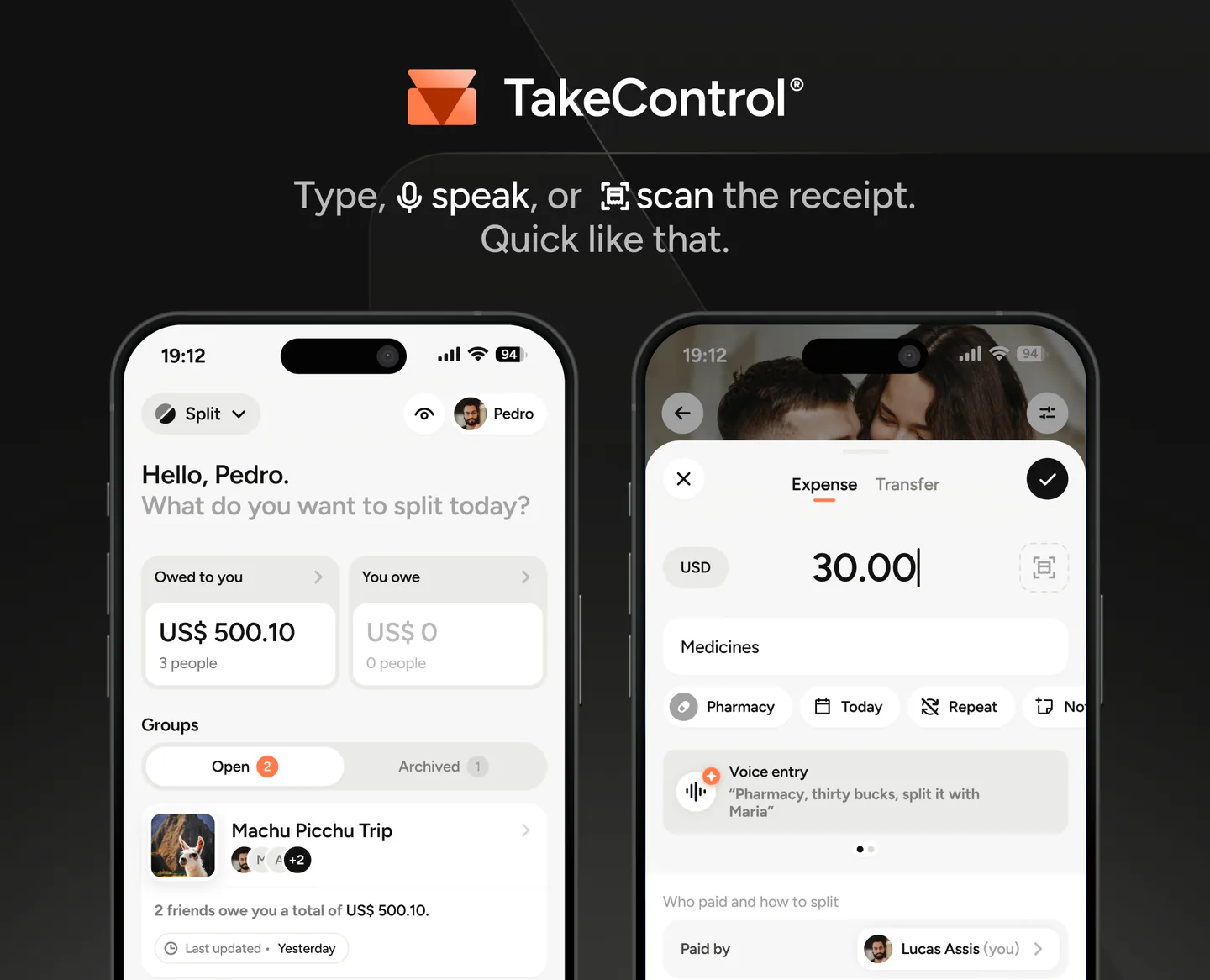
TakeControl lets you type an expense, speak it, or start with a receipt photo. Review the result before saving. Automation can reduce typing, but the amount and participants still need a human check.
Split by actual participation, not headcount
An equal split is right when everyone received the same thing. When that is not true, the entry should reflect what happened.
Picture six friends in Montréal:
- all six share a C$72 airport van;
- four take a C$160 food tour;
- three share a C$24 ride back to the rental;
- one person buys a C$35 souvenir.
The first three are shared expenses with different sets of participants. The souvenir is personal and does not need to enter the group ledger. Excluding people at the time of entry is cleaner than charging everyone and inventing corrections later.
If one traveler stays fewer nights, do not apply one rough percentage to the entire trip. Use the rule that fits each item: nights used for lodging, diners present for a meal, and passengers for a ride. Fair treatment does not require the same formula on every expense.
Download TakeControl, create the trip, and test the workflow with one real booking before departure.
Run a two-minute review each evening
An evening check is not a demand for payment. Open the list after dinner and ask:
- Is any payment from today missing?
- Is an amount or currency wrong?
- Was someone included or left out by mistake?
- Is there a duplicate entry?
- Has one person’s amount due become uncomfortably high?
This small habit finds errors while everyone still remembers the situation. There is no need to audit every bank statement. Each payer confirms their entries; the group discusses only the items that look unusual.
TakeControl’s home-screen widget can show group balances, recent expenses, and budget progress on iOS and Android. The group can also set a daily limit or a budget for the whole trip. Treat that budget as a pace check, not an order for every traveler to spend the same amount personally.
Keep recording when the signal disappears
Flights, mountain roads, ferries, and international data plans all create gaps in service. Waiting for hotel Wi-Fi is how small cash purchases disappear.
TakeControl supports offline expense entry and syncs after the connection returns. If several people log items while offline, review the list once everyone reconnects—especially before re-entering something that appeared not to save.
On an international trip, keep each purchase in the currency used at checkout. Adding US$40 and €40 in a manual total hides important information. The guide to splitting travel expenses in multiple currencies explains how to use a reference currency without erasing the original amounts.
Do not confuse an app balance with a money transfer
An expense app calculates debts; it does not prove that money moved. If Maya paid $900 for lodging and Jordan paid $300 for meals, the balance shows the adjustment after participation is counted. It does not mean a transfer has taken place.
Choose a settlement rhythm that fits the trip:
- at the end, for a weekend with manageable totals;
- every three or four days, for a longer trip;
- at a balance threshold, such as $500 owed to one person;
- after major bookings, so one organizer does not carry every deposit.
Once the e-transfer, bank transfer, or other payment is confirmed, record a settlement in the app. Do not add a negative expense called “payment.” A settlement has its own purpose and keeps the history understandable.
Close the trip without rebuilding the math
On the last day, pause entries for five minutes and complete a final review. Start with lodging, transportation, and high-cost activities, then check small cash purchases. Fix participants and duplicates before anyone sends money.
Then:
- read each person’s balance;
- confirm who pays whom and how much;
- send the money through the chosen method;
- record each completed settlement;
- keep the group archived until everyone confirms.
Do not repay every coffee to its original payer. Simplified balances reduce the number of transfers without changing what each traveler owes overall.
If the group is still choosing a tool, compare offline access, currencies, unequal splits, and entry friction in our guide to expense-splitting apps. The best app is the one the whole group can actually use while the trip is happening.
Phone-based tracking is not about policing the vacation. It is about removing bookkeeping from the conversation. When the amount, payer, and participants are captured immediately, the group comes home with photos and stories—not a spreadsheet to reconstruct.
Start a trip in TakeControl and let the balance update with every payment.

I created TakeControl to make splitting expenses between couples and on trips simpler. Here, I share tips, app updates, lessons learned, and content to make managing shared expenses easier.
Frequently asked questions
Use one shared trip, enter purchases as they happen, and check four fields every time: amount, currency, payer, and participants. A brief evening review catches omissions before the details are forgotten.
Not necessarily. One or two people can handle entries if every payer sends the details immediately. Letting everyone use the same app usually spreads the work and makes the record easier to verify.
Include only the people who used or benefited from that purchase. A rideshare taken by three travelers should not automatically be split among all six people on the trip.
A final settlement is often enough for a short trip. On a longer one, set a balance threshold or settle every few days so one person does not keep funding the whole group.
Use an app with offline entry and let it sync when service returns. TakeControl can record expenses offline, which is useful on flights, road trips, ferries, and anywhere with unreliable data.
No. It calculates and organizes who owes whom, while the group sends money through its preferred payment method. Mark a settlement as paid only after the transfer is confirmed.
