















Blended family finances: how to split household and children’s expenses
A practical system for separating household, couple, and child-specific costs in a blended family, with clear rules and a monthly example.

A new household may begin on moving day, but its finances do not start from a blank page. One or both partners may bring children, support payments, school fees, debts, property, savings goals, and financial arrangements with another parent.
That is why “Should we split everything 50/50?” is usually the wrong first question. A workable blended-family budget identifies what belongs to the shared home, what the couple chooses together, and what remains tied to a particular child or earlier commitment.
This guide covers day-to-day organization, not child support, custody, estate planning, or ownership law. Those rules vary by location and circumstances. If you first need to compare equal and income-based approaches, use our complete couples expense guide and the couples expense-splitting calculator.
Put the existing financial picture on the table
Before designing a shared budget, each partner should show the commitments they are bringing into it. Build an inventory that includes:
- take-home income that is actually available;
- child support paid or received and other existing arrangements;
- recurring school, health, transportation, clothing, and activity costs;
- debts and obligations created before the relationship;
- the expected cost of the new household;
- individual, couple, and family goals.
Do not silently treat money intended for a child as general disposable income. Record it according to its purpose and the applicable arrangement. If either partner is unsure whether a payment is required, reimbursable, or connected to ownership, confirm that outside the monthly budgeting conversation with a qualified local professional.
The Financial Consumer Agency of Canada’s guide to managing money as a couple outlines several valid structures, from pooled accounts to separate finances, and recommends discussing how much each person will contribute to shared expenses. A blended family needs the same conversation, plus explicit treatment of earlier family responsibilities.
Use three buckets instead of one giant pool
Three categories make the ambiguous expenses easier to discuss:
| Budget bucket | Typical examples | The deciding question |
|---|---|---|
| Shared household | rent, utilities, internet, maintenance, ordinary groceries | what keeps the home running for everyone? |
| Couple | dates, a trip for two, shared subscriptions, a joint goal | what exists because the partners chose it together? |
| Child-specific responsibilities | support, tuition, medical care, activities, clothing, prior agreements | what is connected to one child or an existing parental commitment? |
Some costs sit between categories. A normal grocery run supports the household; a school uniform is child-specific. Sunday lunch may be a family activity; one child’s class trip is not. Consistency matters more than finding a philosophically perfect label.
Consider adding a fourth line for whole-family experiences such as outings, holidays, and celebrations. These are shared choices, but separating them from essential household costs makes it easier to set limits without making children feel like line items.
Assign a rule to each bucket
You do not have to use the same split everywhere. Four methods cover most real-life situations:
- Equal split: simple when incomes and outside commitments are broadly similar.
- Income-based split: each partner pays a percentage based on clearly defined available income.
- Fixed contributions: each person transfers an agreed amount to the household budget.
- Participation-based split: useful for a trip, activity, or purchase that does not include everyone.
For the shared household, an income-based or fixed contribution is often easier than allocating every grocery item by head count. If one child lives in the home full time and another visits two weekends a month, the couple can reflect that meaningful difference in the monthly household estimate. Counting individual meals, showers, or nights tends to create work without creating trust.
For child-specific expenses, a reasonable starting point is for each parent to handle their existing commitments. A partner may voluntarily help with an activity or experience, but that choice should be named. Unspoken generosity should not harden into an assumed permanent obligation.
Run the plan through a realistic example
Maya brings home $6,000 a month and has a daughter in the household most weekdays. Chris brings home $4,000 and has two children who stay on alternating weekends. After listing support and other fixed commitments, they agree that those figures are the income bases for their shared plan.
Maya has 60% of the combined income and Chris has 40%.
| Monthly item | Chosen rule | Maya | Chris |
|---|---|---|---|
| Shared household: $3,500 | income-based, 60/40 | $2,100 | $1,400 |
| Couple fun fund: $500 | equal | $250 | $250 |
| School, health, and activities | each parent handles their own commitments | individual | individual |
| Whole-family day trip: $400 | 60/40 for that month | $240 | $160 |
This is an example, not a recommended universal ratio. It shows the value of different rules: the couple protects the household in proportion to income, treats their shared leisure equally, and keeps child-specific commitments visible.
If one partner’s earnings change from month to month, choose a rolling average or conservative baseline and a scheduled review date. Our guide to splitting bills with variable income explains how to avoid changing the percentage every time a payment arrives.
Do not confuse household cash flow with ownership
Contributing to the costs of a home does not automatically mean acquiring an ownership interest in it. A mortgage payment may combine the cost of having a place to live with equity that belongs to an owner. If one partner owns the home, spell out what the other contribution covers: utilities, an agreed housing contribution, maintenance, or another defined expense.
A budgeting app or spreadsheet cannot settle property rights, reimbursement for renovations, inheritance, or what happens after a breakup or death. If those stakes are present, put the appropriate documents in place with independent professional advice. The budget should follow the agreement, not substitute for it.
Bank accounts are a separate choice. Some couples keep individual accounts and fund one household account; others pay from separate cards and settle a running balance. Compare the practical trade-offs in our guide to joint and separate accounts.
Agree on exceptions before they become emergencies
Ordinary bills are rarely the only source of tension. Talk ahead of time about:
- birthdays, holidays, and gifts for each child;
- trips with the whole family, as a couple, or with one parent and their children;
- laptops, orthodontic care, camps, and other large purchases;
- financial help for adult children;
- changes in the parenting schedule;
- urgent costs and how they will be documented;
- a future child shared by the couple.
You do not need a price for every scenario. Decide who joins the decision, which budget bucket pays, and whether a contribution is a gift, a shared expense, or an amount expected to be repaid.
Keep financial negotiations between adults. Children can learn age-appropriate household rules, but they should not carry payment messages or hear themselves compared as costs. The system is meant to support family life, not turn belonging into an invoice.
Hold a short monthly close
Pick one date and use the same 20-minute routine:
- confirm household expenses and who paid them;
- move any child-specific cost that landed in the wrong bucket;
- settle the shared balance;
- preview next month’s unusual expenses;
- note changes in income, parenting time, or earlier arrangements;
- write down exceptions that apply only to the next period.
A short, predictable check prevents a stream of small reimbursements from becoming a larger argument. Use the system in our recurring household expenses guide to keep due dates, payers, and repeating bills visible.
Use TakeControl after the agreement is clear
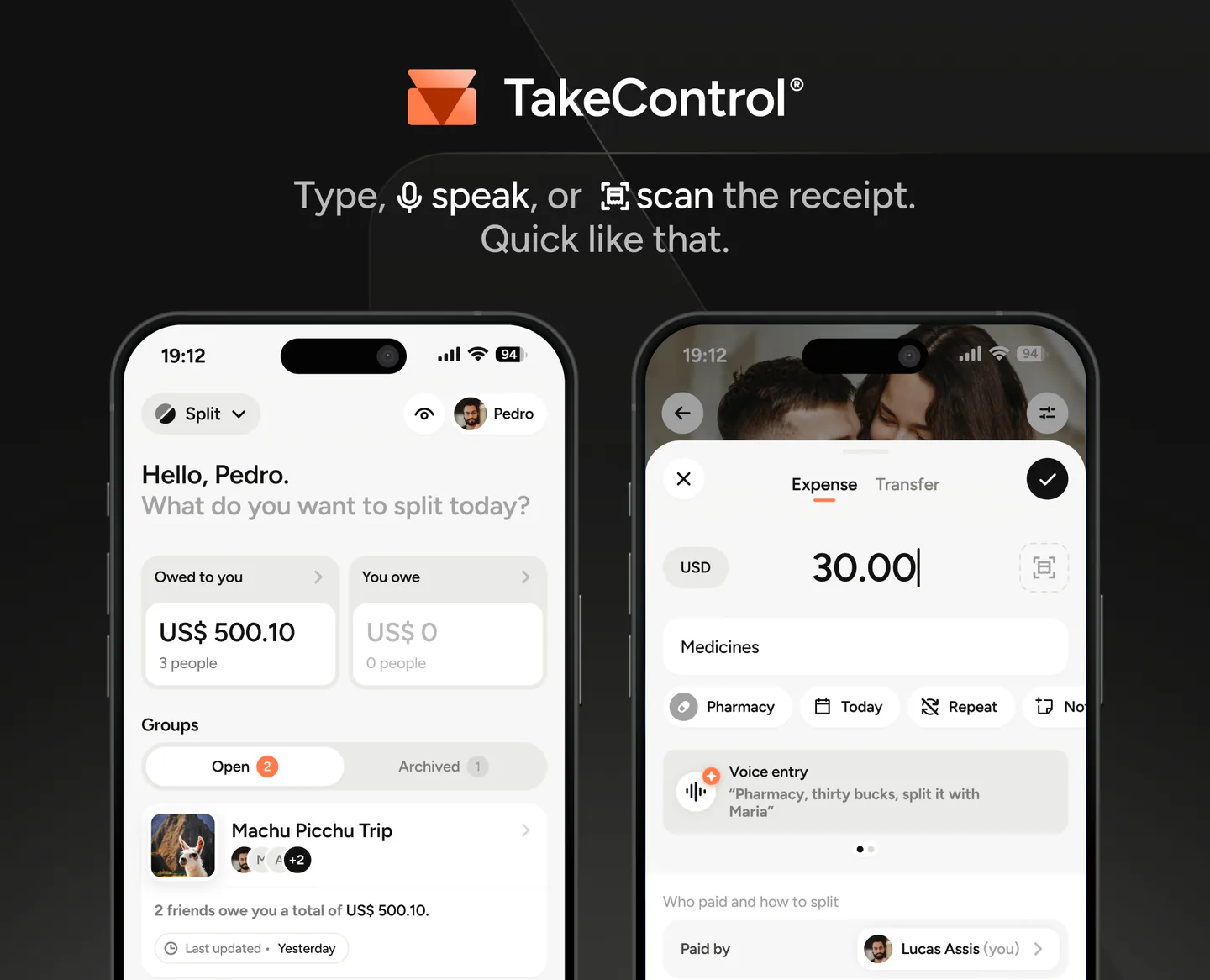
Create a household group in TakeControl, record who paid each bill, and choose an equal, percentage, or exact-amount split as appropriate. The running balance shows how much each adult has already covered, so the couple can settle once instead of sending money back and forth after every purchase.
Personal spending and child-specific commitments can remain outside the household group. A family vacation can use its own group and its own temporary split. TakeControl keeps the record; the adults still decide what belongs in it.
Download TakeControl once the categories and rules are agreed, then use the monthly close to make sure the real transactions still match the plan.
Fair does not have to mean identical
A blended family does not need to pretend every obligation began with the current relationship. It also does not need two financial lives that never meet. The useful middle ground is a genuinely shared home with visible boundaries around earlier commitments.
Start with the three buckets, choose one rule for each, and test the arrangement for two or three months. If both partners can explain the system without searching old messages, it is becoming a reliable family process.

I created TakeControl to make splitting expenses between couples and on trips simpler. Here, I share tips, app updates, lessons learned, and content to make managing shared expenses easier.
Frequently asked questions
Start by separating shared household costs, expenses chosen by the couple, and costs tied to a particular child or prior commitment. Give each bucket its own rule instead of forcing the entire budget into one 50/50 split.
That is a household decision as well as a question that may be affected by local law and existing agreements. A couple may keep child-specific costs with each parent while sharing household and family activities. Get local professional advice for legal obligations.
Not necessarily. Many couples treat housing, utilities, and ordinary groceries as one household budget and split it between the adults by income or fixed contributions. A monthly adjustment can reflect a major difference in parenting time without counting every meal.
Decide before booking whether the event is a whole-family expense or something one parent is arranging with their children. Agree on the budget, participants, split, and extras for that trip rather than assuming the everyday household rule applies.
No. A joint household account can be convenient, but separate accounts plus a shared tracking system can work just as well. Keep cash-flow contributions distinct from property ownership and earlier obligations.
Yes. In a household group, record who paid and split each expense equally, by percentage, or by exact amount. Personal and child-specific costs can stay outside that group, while vacations can use a separate group.
