















Authorized user or separate credit cards: what works best for couples?
Compare an authorized-user card with separate credit cards for couples: bills, limits, rewards, responsibility, autonomy, and shared spending.

The choice between an authorized user and separate credit cards for couples is not really about how many pieces of plastic sit in two wallets. It is about who owns the account, who owes the issuer, what each partner can see, and how shared purchases fit into the household budget.
One account can make groceries, gas, and subscriptions easier to consolidate. Separate accounts can protect flexibility when each partner already has a useful card, an established credit history, and personal spending that does not belong on a household statement.
This decision is separate from choosing joint or separate bank accounts. A couple can keep separate checking accounts and share one credit-card account, or use a joint checking account while keeping credit cards individual.
Start with the account roles, not the card design
An authorized user receives a card linked to someone else’s credit-card account. Purchases normally appear on the same account statement and use the account’s available credit. The primary cardholder controls the relationship with the issuer.
With separate cards, each partner has an individual account, statement, due date, credit line, and rewards program. A purchase can still be shared between the couple; the payment account is simply not shared.
Do not confuse an authorized user with a joint account holder or co-borrower. Those roles can carry different repayment obligations. The U.S. Consumer Financial Protection Bureau explains that each holder on a joint credit-card account can be responsible for the full balance. In Canada, the Financial Consumer Agency of Canada distinguishes primary cardholders, authorized users, and co-borrowers.
Before adding a partner, ask the issuer:
- Is the second person an authorized user, additional cardholder, or co-borrower?
- Who is contractually responsible for the balance?
- Can the primary cardholder set an individual spending limit?
- Which person can see transactions, freeze a card, or dispute a charge?
- Is there an annual fee for the extra card?
- Which rewards, insurance, and travel benefits apply to the second card?
- Does the issuer report authorized users to credit bureaus?
Why couples choose an authorized-user card
The clearest advantage is consolidation. If both cards are reserved for shared costs, recurring bills and daily household purchases arrive in one place. The couple can review one statement, pay one account, and avoid sending money after every grocery run.
Rewards may also collect in the primary account. That can be useful when concentrating spend unlocks a reward the household will genuinely use. It is less useful when an extra-card fee absorbs the value or when one partner gives up a better category bonus on an individual card.
This setup tends to work when:
- the couple has agreed on what counts as household spending;
- the primary cardholder is comfortable carrying the account responsibility;
- both partners can see enough information to catch mistakes;
- the shared credit line is large enough without encouraging overspending;
- the statement identifies purchases by cardholder; and
- one rewards program is actually valuable to both people.
Suppose Morgan and Riley use the linked cards only for groceries, public transit, household supplies, and shared meals. Personal shopping stays on individual cards. The monthly statement then represents a useful household category rather than a record of their entire private lives.
Where one shared account can go wrong
An agreement between partners does not rewrite the issuer’s contract. If the primary cardholder is responsible for the balance, “you will pay me back later” does not shift that obligation to the bank.
The shared credit line can also create surprises. One large purchase may leave less available credit for the other card. Some issuers offer alerts or user-level caps, but the controls vary. Couples should test them rather than assume a limit shown in the app is a hard stop in every situation.
Privacy is another practical issue. A gift, a hobby purchase, or lunch with a friend may appear beside the power bill and groceries. Complete secrecy is not a healthy financial plan, but financial transparency does not require putting every personal purchase on the same statement.
There can also be an imbalance in access. The primary cardholder may be able to remove the authorized user, change controls, or close the account. That arrangement may be acceptable, but both people should understand it before treating the card as equally owned.
Why separate credit cards may be the cleaner choice
Individual accounts let each partner choose a card for their own priorities: cash back, travel protection, a low interest rate, no annual fee, or a relationship with a preferred bank. Each person manages a separate due date and available credit.
Personal spending stays personal by default. Separate accounts can also matter when both partners want to maintain credit in their own names. Credit-reporting effects vary, so an authorized-user entry should not be treated as a guaranteed substitute for an individual account.
The weakness is not the separation itself. It is the lack of a shared-expense process.
If Alex pays $310 for groceries and Sam pays $95 for utilities and $70 for gas, the couple needs more than two statements to know the fair result. Screenshots, texts, and memory become unreliable once recurring costs and returns enter the picture. Our guide to managing recurring household expenses as a couple can help define that routine.
Side-by-side comparison
| Question | Authorized-user arrangement | Separate credit cards |
|---|---|---|
| Monthly statement | Usually one account statement | One statement per account holder |
| Available credit | Generally shared at the account level | Each person has an individual credit line |
| Responsibility to issuer | Commonly rests with the primary cardholder | Each holder is responsible for their account |
| Transaction access | Depends on the issuer and account role | Each person controls their own account |
| Rewards | Usually flow to the primary account | Stay in each card’s program |
| Personal autonomy | Lower within the shared account | Higher |
| Household tracking | Easy if the account is household-only | Needs a separate tracking method |
| Personal purchases | Can mix into the shared statement | Naturally stay separate |
Four real-life cases
Most card spending is for the household
An authorized-user card dedicated to shared purchases can reduce administration. Keep the categories narrow, agree on a discussion threshold for large charges, and decide which bank account will pay the statement.
Each partner already has valuable card benefits
Separate cards may deliver more value. One partner might use a grocery cash-back card while the other has travel coverage. Record the shared nature of the purchase without forcing every expense through one rewards program.
Incomes are different
The payment method does not determine the split. A $2,400 shared subtotal can be divided equally, 60/40, or using another rule. The couples expense-splitting calculator lets you compare an equal contribution with an income-based one.
Sharing a credit line feels uncomfortable
Keep individual cards. If you want to test consolidation, start with an authorized-user card for two predictable categories and a modest user limit, if the issuer supports one. There is no need to move every subscription on day one.
A hybrid system often survives real life better
Many couples do not need an all-or-nothing decision. A flexible setup can include:
- individual cards for personal expenses;
- one authorized-user account used only for agreed household categories; and
- a shared record for costs paid by bank transfer, cash, or another card.
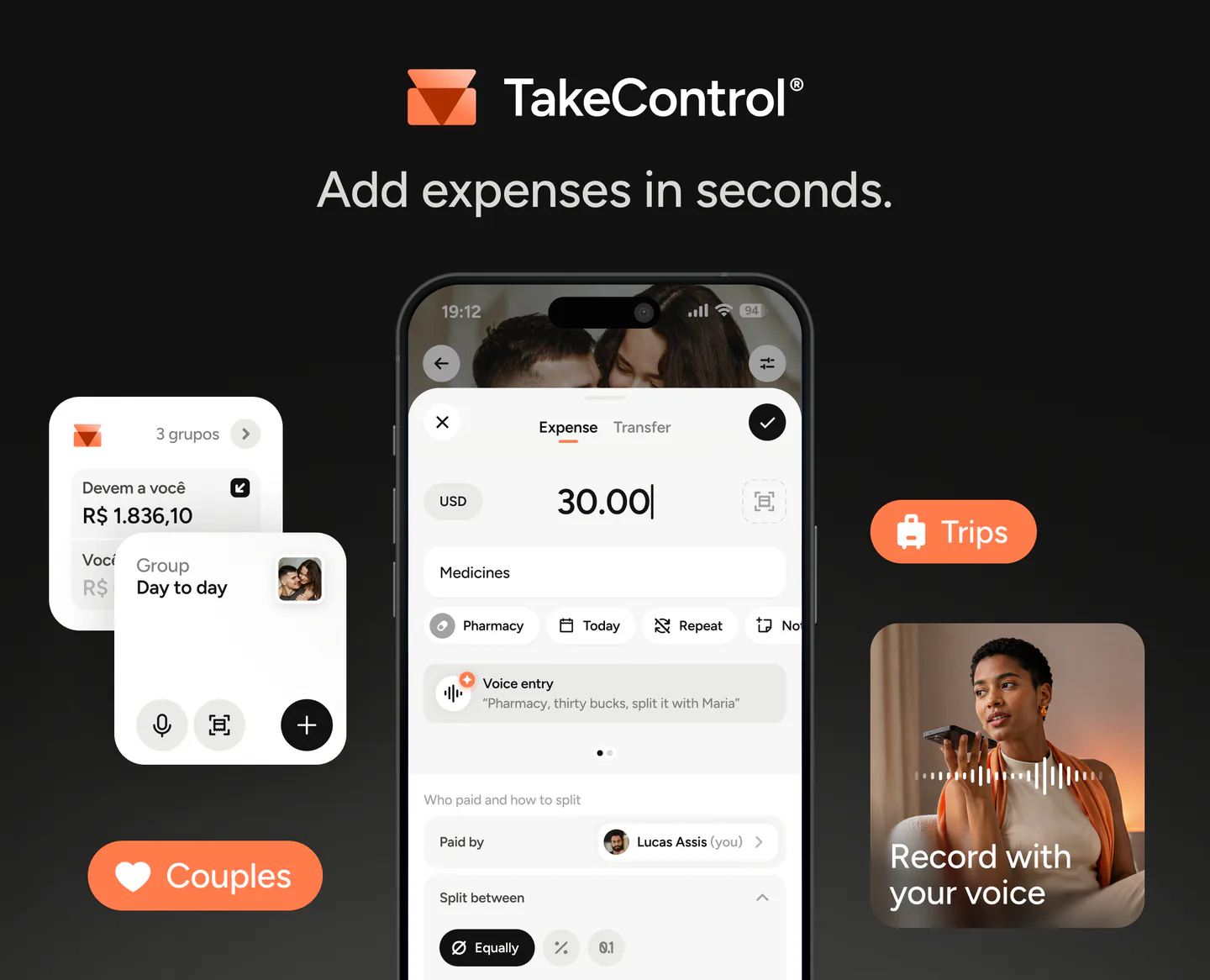
You can also keep every credit card separate and share only the accounting. In TakeControl, a couple records who paid, who participates, and whether the expense is split equally, by percentage, or by exact amount. The running balance shows who is ahead without requiring a transfer after every purchase.
TakeControl does not issue a card, move money, or change anyone’s legal responsibility to an issuer. It organizes the agreement between the two people. If you still need to decide what belongs in that agreement, start with the complete guide to splitting expenses as a couple.
Agree on these rules before adding a user
Write down a short operating agreement:
- Which spending categories belong on the shared card?
- Which purchases stay personal?
- What dollar amount requires a conversation first?
- How will the shared subtotal be divided?
- Who schedules and verifies the payment?
- How will both partners monitor available credit?
- What happens if income, card terms, or the relationship changes?
Run the arrangement for one billing cycle before moving every recurring charge. At the end, check whether the statement became clearer, whether access felt balanced, and whether the rewards exceeded the fees and lost flexibility.
Which option should you choose?
Choose an authorized-user card when the priority is one place for shared purchases, fewer reimbursements, and concentrated rewards—and both partners understand that control and repayment responsibility may not be equal.
Choose separate credit cards when the priority is individual control, independent limits, and the freedom to use different benefits—provided you have a dependable way to settle shared spending.
The healthiest arrangement is not the one that looks most merged. It is the one that makes ownership, household spending, and payment responsibility obvious before the statement arrives.
Download TakeControl for free and organize shared expenses without depending on one card setup.
 Download for iPhone
 Download for Android

I created TakeControl to make splitting expenses between couples and on trips simpler. Here, I share tips, app updates, lessons learned, and content to make managing shared expenses easier.
Frequently asked questions
Use an authorized-user card when centralizing shared purchases and one monthly bill matters most. Keep separate cards when individual limits, rewards, credit profiles, and spending privacy matter more. The best choice depends on legal responsibility, account access, fees, and how you track household costs.
In the United States and Canada, the primary cardholder is generally responsible for the account balance, while an authorized user usually is not a co-borrower. Issuer agreements and local law matter, so check the card’s current terms before adding anyone.
Usually both cards use the same account credit line. Some issuers let the primary cardholder set an authorized-user spending limit, while others do not. Confirm how the control works and whether pending transactions count against it.
It depends on the country, issuer, and reporting practice. Some issuers report authorized-user accounts to credit bureaus, but that is not the same as owning an individual account. Do not assume the arrangement will build independent credit without checking.
First separate household purchases from personal ones. Then apply the couple’s chosen rule to the shared subtotal—such as 50/50, an income-based percentage, or exact amounts. The card statement itself does not require an equal split between partners.
Often, purchases made by an authorized user earn rewards in the primary account. Fees, travel benefits, insurance, lounge access, and bonus eligibility may differ for the second card, so review the issuer’s current benefit guide before choosing.
